Repository navigation
Folder Management
Docker and VM configurations are separate, but their folder concepts are intentionally consistent.
- Open Basic Settings and choose Docker or VMs.
- Select Add folder/group, then Single folder.
- Enter the name, choose an icon or keep the default, and select Create folder.
- Open the folder editor to choose a parent, assign members, review the preview, and save.
Use Preconfigured groups for the setup wizard's categories and Smart suggestions. Select the desired folders and choose Create folders; matching existing folder names are skipped.
Use My groups to save your own named collection of folder names and icons. Save group stores the template without creating folders. Reopen it under Saved groups to edit or deploy it. Deleting a saved group leaves deployed folders intact. Docker and VM groups are stored separately on the server, with up to 30 groups per type and 50 folders per group. Groups create root folders using the existing creation defaults and do not copy member assignments.
Screenshot placeholder — current Basic folder management
Capture the Docker/VM folder list, direct-member/child counts, compact toolbar, Add folder/group popup, and Edit folder defaults link in stable 2026.10.13.06. Include a parent with no direct members and a populated child while Hide Empty Folders is enabled. The previous image showed a runtime table rather than these Settings controls.
- A folder may be placed beneath another folder using the parent picker.
- The Members tab contains direct container or VM assignments; child folders are separate hierarchy nodes.
- A member should normally have one effective folder.
- Moving a parent keeps its branch together.
- Names must be unique among siblings; the same name may be meaningful in separate branches when no collision exists.
- The maximum hierarchy depth is six levels. Shallow, purpose-driven branches are easier to operate.
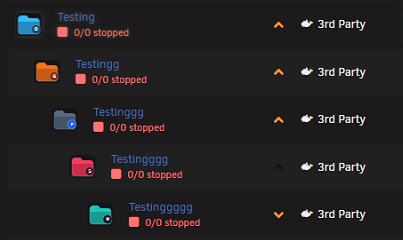
Basic Docker/VM nested rows use curved branches with circular endpoints and inset name panels. Drag and folder-action controls have separate spacing and a divider; branch guides follow the visible collapsed/filtered list. Mobile reorder remains available.
In Manage Folders, Hide Empty Folders includes effective members in child folders and deeper descendants. A parent with no directly assigned containers or VMs remains visible whenever a descendant contains members, including regex or rule matches. An entirely empty branch remains hidden. While runtime membership is still loading, Settings preserves the configured rows rather than temporarily hiding a valid branch. The setting changes visibility without removing folders or assignments.
The Docker runtime page follows the same populated-ancestor rule in stable 2026.10.05.06 or newer, using containers actually grouped into the branch. If a populated parent disappears, update to that version or newer and hard-refresh. Toggle Hide Empty Folders off/on, refresh folder state, and verify the parent/child arrangement in both Settings and Docker. See Troubleshooting.
Manual order uses the six-dot handles and one-step arrow controls. Name/timestamp modes calculate order automatically. Pinned folders are resolved before the selected sort mode. Switch to manual before expecting a drag or arrow operation to define the full order.
Nested pinning promotes the root branch when visible order is calculated; it does not detach the nested folder from its parent.
Available sort modes are Created order, Created newest, Created oldest, Last updated, Manual, Name A–Z, and Name Z–A. Quick filters such as Pinned, Stopped, Empty, No rules, and Has updates change the current Settings view without deleting or reordering data.
On small/touch screens, use Mobile reorder instead of relying on desktop drag behavior. Inline hierarchy undo/redo can reverse recent local tree moves before a broader restore is needed.
Use highlighted Before, Inside, and After targets to move a branch immediately, or choose Move folder for keyboard use. Before/After sets Manual sorting; Inside/root keeps the current sort mode. Parent and position save together with revision protection. A failed save restores the previous row position; successful saves do not scroll back to it.
Routine moves/reorders and pin/preference changes no longer create a backup for every adjustment. Tree Undo/Redo is current-session history; Recovery's safety-snapshot undo is separate. Create a manual snapshot before a large reorganization if you need recovery after closing this session.
On the Docker runtime page, saved folder positions can be mixed with standalone containers. Refresh preserves those slots, and folder sorting rearranges folders within them. New folders without a saved slot initially appear at the top. This native-page arrangement is separate from the folder-only Settings list and from FolderView3 migration, which does not import unassigned native-item positions.
The Docker folder menu's Move to root action updates the hierarchy immediately and keeps an expanded branch open. The former parent's member totals and preview update at the same time; collapsing it no longer hides the moved root. A failed save restores the previous on-screen hierarchy. See Docker folder moves.
Collapsed previews can include selected direct members and child-folder summaries without changing actual membership. You can control preview depth, member inclusion, icon/label/status/action visibility, and child folder inclusion.
If every member is excluded from preview, the UI shows an explanatory empty state. Expanding the folder still reveals native rows.
The action sheet is context-sensitive. Depending on type, state, lock, hierarchy, and member eligibility, it can offer:
- Edit, focus, pin/unpin, lock/unlock, expand, or collapse.
- Start, stop, pause, resume, restart, or update eligible members.
- Move within the current level, move under a parent, or return to root.
- Clone, export branch, import into branch, scan, repair, or delete.
- Copy folder ID for diagnostics or advanced integrations.
Review destructive confirmations. Deleting a branch can affect nested folders, and runtime actions can affect several workloads at once.
Docker and VM view settings can save defaults for newly created folders. Save as defaults changes the starting values for future folders and does not rewrite existing folders. Apply to all is a separate explicit bulk operation that intentionally applies supported defaults to existing folders after review. Clear defaults returns future folders to the normal plugin baseline.
Use Edit folder defaults directly below the Docker or VM summary in Settings to open the saved profile, including imported FolderView3 defaults. Change its icon, appearance, preview, or transferable actions and choose Save as defaults. The defaults editor does not create a folder, assign members, or change existing folders. Docker and VM defaults remain separate. Name, parent, membership, and member-specific WebUI profiles are not part of the saved default profile.
Screenshot placeholder — defaults editor
Capture the Edit folder defaults link and the defaults editor with Save as defaults visible, using a fictional profile.
Basic Settings provides Tree scan and Tree repair for Docker and VMs.
The scan is read-only and reports:
- A folder referencing itself as parent.
- A parent ID that no longer exists.
- Cyclic parent chains.
- Depth beyond the six-level limit.
- Empty branches as an advisory condition.
Self-links, orphan parents, and cycles are repairable link errors. Depth and empty-branch findings are advisory: automatic repair does not reorganize or delete them for you.
Tree repair refreshes current state, requires a valid expected revision, asks for confirmation, and creates a verified backup. It resets only selected invalid parent links to root, offers undo, reloads the saved tree, and reports remaining link errors and advisory warnings.
Screenshot placeholder — hierarchy scan result
Capture fictional self-parent/orphan findings plus a depth advisory, with repairable and advisory counts visible.
- Create a Recovery snapshot.
- Switch sorting to manual if order matters.
- Move one branch at a time.
- Verify direct members and children on the runtime page.
- Check Dashboard if that type is displayed there.
- Use recent-change undo when offered; otherwise restore the safety snapshot.
- Confusing a hidden preview member with removed membership.
- Expecting manual dragging to persist while an automatic sort mode is active.
- Assigning the same member through overlapping rules without checking priority.
- Deleting a parent without reviewing the nested branch.
- Using folder names as permanent automation identifiers when folder IDs are available.