



A Payload CMS plugin that adds vector search capabilities to your collections. Perfect for building RAG (Retrieval-Augmented Generation) applications and semantic search features.
Status:
0.x— pre-1.0. The public API is stabilizing but may still have breaking changes between minor releases. Track the CHANGELOG before upgrading.
- 🔍 Semantic Search — vectorize any collection for intelligent content discovery.
- 🚀 Realtime ingestion — documents are automatically vectorized on create/update and embeddings are deleted on document delete.
- 🧵 Bulk embedding — "Embed all" batches that backfill only documents missing the current
embeddingVersionsince the last bulk run, to save money. - 🔌 Database Adapters — pluggable architecture supporting different database backends.
- ⚡ Background Processing — uses Payload's job system for non-blocking vectorization.
- 🎯 Flexible Chunking — drive chunk creation yourself with
toKnowledgePoolfunctions so you can combine any fields or content types. - 🧩 Extensible Schema — attach custom
extensionFieldsto the embeddings collection and persist values per chunk for querying. - 🌐 REST API — built-in vector-search endpoint with Payload-style
wherefiltering and configurable limits. - 🏊 Multiple Knowledge Pools — separate knowledge pools with independent configurations.
- Database Adapters
- Prerequisites
- Installation
- Quick Start
- Configuration Options
- Metadata Filtering (
where) - Chunkers
- Bulk Embeddings API
- Validation & Retries
- API Reference
- Troubleshooting
- Videos
- Architecture
- Community
- Changelog
- License
This plugin requires a database adapter for vector storage. Available adapters:
| Adapter | Package | Database | Documentation |
|---|---|---|---|
| PostgreSQL | @payloadcms-vectorize/pg |
PostgreSQL with pgvector | README |
| Cloudflare Vectorize | @payloadcms-vectorize/cf |
Cloudflare Vectorize index | README |
| MongoDB | @payloadcms-vectorize/mongodb |
MongoDB Atlas + self-hosted 8.2+ | README |
See adapters/README.md for information on creating custom adapters.
- Payload CMS 3.x — actively tested on
3.69.0. Older 3.x releases (e.g.3.37.0) have worked historically but are not part of the current test matrix; newer 3.7x+ releases have not yet been validated. If you hit issues on a different 3.x version, please open an issue. - A supported database with vector capabilities (see Database Adapters)
- Node.js 18+
# Install the core plugin
pnpm add payloadcms-vectorize

# Install a database adapter (one of the following)
pnpm add @payloadcms-vectorize/pg        # PostgreSQL + pgvector
pnpm add @payloadcms-vectorize/cf        # Cloudflare Vectorize
pnpm add @payloadcms-vectorize/mongodb # MongoDB Atlas + self-hosted 8.2+First, configure your database adapter. See the adapter-specific documentation:
- PostgreSQL: @payloadcms-vectorize/pg README — pgvector setup, schema initialization, and migrations.
- Cloudflare Vectorize: @payloadcms-vectorize/cf README — index creation, bindings, and known limitations.
- MongoDB: @payloadcms-vectorize/mongodb README — Atlas / self-hosted 8.2+,
filterableFields, and the$vectorSearchindex lifecycle.
The example below is runnable as-is — it uses Voyage AI's embedding API for realTimeIngestionFn / queryFn and a trivial toKnowledgePool that emits one chunk per post. Drop in your own embedding provider or chunker as needed; for richer chunking helpers, see Chunkers.
pnpm add ai voyage-ai-providerimport { buildConfig } from 'payload'
import { postgresAdapter } from '@payloadcms/db-postgres'
import { createPostgresVectorIntegration } from '@payloadcms-vectorize/pg'
import payloadcmsVectorize from 'payloadcms-vectorize'
import type { ToKnowledgePoolFn } from 'payloadcms-vectorize'
import { embed, embedMany } from 'ai'
import { voyage } from 'voyage-ai-provider'
// 1) Embedding functions — Voyage AI
const embedDocs = async (texts: string[]): Promise<number[][]> => {
const { embeddings } = await embedMany({
model: voyage.textEmbeddingModel('voyage-3.5-lite'),
values: texts,
providerOptions: { voyage: { inputType: 'document' } },
})
return embeddings
}
const embedQuery = async (text: string): Promise<number[]> => {
const { embedding } = await embed({
model: voyage.textEmbeddingModel('voyage-3.5-lite'),
value: text,
providerOptions: { voyage: { inputType: 'query' } },
})
return embedding
}
// 2) Convert a document into chunks + extension-field values.
// Each entry becomes one embedding row; the array index is the `chunkIndex`.
const postsToKnowledgePool: ToKnowledgePoolFn = async (doc) => {
const entries: Array<{ chunk: string; category?: string; priority?: number }> = []
if (doc.title) {
entries.push({
chunk: doc.title,
category: doc.category ?? 'general',
priority: Number(doc.priority ?? 0),
})
}
if (typeof doc.body === 'string' && doc.body.length > 0) {
entries.push({
chunk: doc.body,
category: doc.category ?? 'general',
priority: Number(doc.priority ?? 0),
})
}
return entries
}
// 3) Database adapter integration. Shape varies by adapter — see the adapter docs.
// Voyage `voyage-3.5-lite` returns 1024-dim vectors.
const integration = createPostgresVectorIntegration({
mainKnowledgePool: {
dims: 1024,
ivfflatLists: 100, // PG-specific index parameter
},
})
export default buildConfig({
// ... your existing config
db: postgresAdapter({
extensions: ['vector'],
afterSchemaInit: [integration.afterSchemaInitHook],
// ... your database config
}),
plugins: [
payloadcmsVectorize({
dbAdapter: integration.adapter,
knowledgePools: {
mainKnowledgePool: {
collections: {
posts: { toKnowledgePool: postsToKnowledgePool },
},
extensionFields: [
{ name: 'category', type: 'text' },
{ name: 'priority', type: 'number' },
],
embeddingConfig: {
version: 'v1.0.0',
queryFn: embedQuery,
realTimeIngestionFn: embedDocs,
// bulkEmbeddingsFns: { ... } // Optional — see Bulk Embeddings API
},
},
},
// Optional plugin options:
realtimeQueueName: 'vectorize-realtime',
// endpointOverrides: { path: '/custom-vector-search', enabled: true },
// disabled: false,
// bulkQueueNames: { // Required only if `bulkEmbeddingsFns` is set
// prepareBulkEmbedQueueName: 'vectorize-bulk-prepare',
// pollOrCompleteQueueName: 'vectorize-bulk-poll',
// },
}),
],
jobs: {
autoRun: [
// The realtime queue must run for create/update vectorization to fire.
{ cron: '*/5 * * * * *', limit: 10, queue: 'vectorize-realtime' },
],
},
})Want richer chunking? See
dev/helpers/chunkers.tsfor a Lexical rich-text chunker anddev/helpers/embed.tsfor the full Voyage real-time + bulk batch implementation.
Important — knowledge pool naming.
knowledgePoolskeys must be different from your collection slugs. Reusing a collection name for a knowledge pool will cause schema conflicts. In the example above, the pool is namedmainKnowledgePooland Payload will create a collection namedmain-knowledge-poolfor the embeddings.
Important — import map. The import map tells Payload how to resolve component paths (like
'payloadcms-vectorize/client#EmbedAllButton') to actual React components. Without it, client components referenced in your collection configs won't render.pnpm run generate:importmapWhen to run it:
- Development: Payload regenerates the import map on startup (HMR), so you usually don't need to run it manually.
- Production builds: You MUST run
pnpm run generate:importmapbeforepnpm build, otherwise custom components won't be found.- If client components don't appear (e.g., the "Embed all" button is missing): regenerate manually.
Migration steps depend on your database adapter:
- PostgreSQL: @payloadcms-vectorize/pg README → Migrations
- Cloudflare Vectorize: index creation is a one-time setup step — see @payloadcms-vectorize/cf README.
- MongoDB: no manual migration — the
$vectorSearchindex is auto-ensured on first write. See @payloadcms-vectorize/mongodb README → Index lifecycle.
The plugin automatically creates a /api/vector-search endpoint:
const response = await fetch('/api/vector-search', {
  method: 'POST',
  headers: { 'Content-Type': 'application/json' },
  body: JSON.stringify({
    query: 'What is machine learning?', // Required
    knowledgePool: 'mainKnowledgePool', // Required — must match a key in your `knowledgePools`
    where: {
      category: { equals: 'guides' }, // Optional Payload-style filter
    },
    limit: 5, // Optional (defaults to 10)
  }),
})

const { results } = await response.json()
For the response shape, see POST /api/vector-search. For programmatic use without HTTP, see vectorizedPayload.search().
| Option | Type | Required | Description |
|---|---|---|---|
knowledgePools |
Record<KnowledgePool, KnowledgePoolDynamicConfig> |
✅ | Knowledge pools and their configurations |
realtimeQueueName |
string |
❌ | Custom queue name for realtime vectorization jobs |
bulkQueueNames |
{prepareBulkEmbedQueueName: string, pollOrCompleteQueueName: string} |
❌ | Queue names for bulk embedding jobs (required if any pool uses bulk ingest) |
endpointOverrides |
object |
❌ | Customize the search endpoint |
disabled |
boolean |
❌ | Disable plugin, except embeddings deletions, while keeping schema |
These options are passed to payloadcmsVectorize for each pool and apply regardless of which database adapter you use.
| Option | Type | Required | Description |
|---|---|---|---|
collections |
Record<string, CollectionVectorizeOption> |
✅ | Collections to embed and their configs. See CollectionVectorizeOption. |
embeddingConfig |
EmbeddingConfig |
✅ | Embedding model + functions. See table below. |
extensionFields |
Field[] |
❌ | Extra columns added to the embeddings collection. Standard Payload field configs. |
embeddingConfig shape:
| Field | Type | Required | Description |
|---|---|---|---|
version |
string |
✅ | Version string for tracking model changes (drives bulk re-embed eligibility). |
queryFn |
EmbedQueryFn |
✅ | Embeds search queries. |
realTimeIngestionFn |
EmbedDocsFn |
❌ | Embeds documents synchronously on create/update. |
bulkEmbeddingsFns |
BulkEmbeddingsFns |
❌ | Streaming bulk-API callbacks. See Bulk Embeddings API. |
Ingestion mode is determined by which functions you provide:
realTimeIngestionFn |
bulkEmbeddingsFns |
Behavior |
|---|---|---|
| ✅ | ❌ | Real-time only — documents are embedded on every create/update. |
| ❌ | ✅ | Bulk only — embedding happens only via manual "Embed all" runs (see Bulk Embeddings API). |
| ✅ | ✅ | Both — real-time on writes, bulk for backfills. |
| ❌ | ❌ | Embedding disabled for this pool. Search still works against existing rows. |
Invariant — embedding deletion cannot be disabled. When a source document is deleted, all its embeddings are removed from every knowledge pool that contains that collection, regardless of how they were created. This is by design and not configurable.
Reserved field names. Avoid using these names in
extensionFields— they're built-in columns on the embeddings collection:sourceCollection,docId,chunkIndex,chunkText,embeddingVersion. They are also valid filter targets inwhereclauses.
embeddingVersionsemantics. Each row stores theembeddingConfig.versionit was created under. Bulk runs only re-embed rows whereembeddingVersiondoesn't match the currentversion(see Embed All (Admin UI)). Bumpversionwhenever you swap models or changetoKnowledgePoolsemantics.
Each adapter has its own configuration shape — this is where index parameters, dimensions, bindings, and other backend-specific settings live. There is no shared schema; refer to the adapter you're using:
- PostgreSQL (
dims,ivfflatLists, schema initialization): @payloadcms-vectorize/pg → Static Configuration - Cloudflare Vectorize (
dims, Vectorize binding): @payloadcms-vectorize/cf → Configuration - MongoDB (
uri,dbName, per-pooldimensions/similarity/filterableFields/numCandidates/forceExact): @payloadcms-vectorize/mongodb → API Reference
The embeddings collection name in Payload will be the same as the knowledge pool name.
Static configuration changes (like vector dimensions) may require migrations. See your adapter's docs for specifics:
- PostgreSQL: Migrations
- Cloudflare Vectorize: dimension changes require recreating the Vectorize index.
See also: reserved field names — don't use them as keys in the entries returned by
toKnowledgePool.
| Option | Type | Required | Description |
|---|---|---|---|
toKnowledgePool |
(doc, payload) => Promise<Entry[]> |
✅ | Returns an array of { chunk, ...extensionFieldValues }. Each entry becomes one embedding row; the array index becomes chunkIndex. |
shouldEmbedFn |
(doc, payload) => Promise<boolean> |
❌ | Runs before the document is queued. Return false to skip entirely (no job, toKnowledgePool never called). Applies to real-time and bulk. Defaults to embedding all. |
batchLimit |
number |
❌ | Max documents per bulk-embed worker job. Each page becomes a separate job that queues a continuation. Useful for serverless time limits. Defaults to 1000. |
Example — skip draft documents:
collections: {
  posts: {
    shouldEmbedFn: async (doc) => doc._status === 'published',
    toKnowledgePool: postsToKnowledgePool,
  },
}Both the /api/vector-search endpoint and vectorizedPayload.search() accept an optional where clause. The clause is a Payload-style Where object evaluated against the embeddings collection plus any extensionFields you defined for the pool. It is applied before the vector similarity ranking, so you only pay similarity cost on the rows you care about.
| Operator | Applies to | Description |
|---|---|---|
equals |
any | Exact match |
not_equals / notEquals |
any | Negated exact match |
in |
any | Value is in array |
not_in / notIn |
any | Value is not in array |
like |
text | SQL LIKE (use % wildcards) |
contains |
text | Substring match (wraps with %…%) |
greater_than / greaterThan |
number / date | > |
greater_than_equal / greaterThanEqual |
number / date | >= |
less_than / lessThan |
number / date | < |
less_than_equal / lessThanEqual |
number / date | <= |
exists |
any | true → IS NOT NULL, false → IS NULL |
Multiple top-level fields are combined with AND. Use and / or arrays for explicit logic, including nested combinations:
where: {
  or: [
    { category: { equals: 'guides' } },
    {
      and: [
        { category: { equals: 'tutorials' } },
        { priority: { gte: 3 } },
      ],
    },
  ],
}You can filter on:
- Reserved fields:
sourceCollection,docId,chunkIndex,chunkText,embeddingVersion - Any field you declared in the pool's
extensionFields
References to fields that don't exist on the embeddings table are silently dropped (the rest of the clause still applies).
Adapter parity. All operators are implemented in
@payloadcms-vectorize/pg. The Cloudflare Vectorize adapter has narrower native filtering — see @payloadcms-vectorize/cf → Known Limitations for what is and isn't supported there. The MongoDB adapter splits the clause into a native$vectorSearchpre-filter and a JS post-filter —like/contains/alland any mixed-pre/postorare post-filtered, so they may return fewer thanlimitrows. See @payloadcms-vectorize/mongodb → WHERE clause behavior.
Use chunker helpers (see dev/helpers/chunkers.ts) to keep toKnowledgePool implementations focused on orchestration. A toKnowledgePool can combine multiple chunkers, enrich each chunk with metadata, and return everything the embeddings collection needs.
const postsToKnowledgePool: ToKnowledgePoolFn = async (doc, payload) => {
  const chunks = await chunkText(doc.title ?? '', payload)

  return chunks.map((chunk) => ({
    chunk,
    category: doc.category ?? 'general',
  }))
}
Because you control the output, you can mix different field types, discard empty values, or inject any metadata that aligns with your extensionFields.
The bulk embedding API is designed for large-scale embedding using provider batch APIs (like Voyage AI). Bulk runs are never auto-queued — they must be triggered manually via the admin UI or API.
The plugin uses separate Payload jobs for reliability with long-running providers:
prepare-bulk-embedding: A coordinator job fans out one worker per collection. Each worker streams through documents, calls youraddChunkfor each chunk, and creates batch records. WhenbatchLimitis set on a collection, workers paginate and queue continuation jobs.poll-or-complete-single-batch: Polls a single batch, requeues itself until done, then writes successful embeddings. When all batches for a run are terminal, the run is finalized (partial chunk failures are allowed).
For bulk embedding, you must provide the bulk queue names and matching cron entries.
plugins: [
  payloadcmsVectorize({
    knowledgePools: { /* ... */ },
    realtimeQueueName: 'vectorize-realtime', // optional
    bulkQueueNames: { // required only if you are using bulk embeddings
      prepareBulkEmbedQueueName: 'vectorize-bulk-prepare',
      pollOrCompleteQueueName: 'vectorize-bulk-poll',
    },
  }),
]

jobs: {
  autoRun: [ // Queue names must match the values above
    { cron: '*/5 * * * * *', limit: 10, queue: 'vectorize-realtime' },
    { cron: '0 0 * * * *', limit: 1, queue: 'vectorize-bulk-prepare' },
    { cron: '*/30 * * * * *', limit: 5, queue: 'vectorize-bulk-poll' },
  ],
}The bulk embedding process has three levels of failure:
- Run level: If any chunk fails during ingestion (
toKnowledgePool), the entire run fails and no embeddings are written. This is fully atomic. YouronErroris expected to handle clean-up from this stage. - Batch level: If any batch fails during polling, the entire run is marked as failed but embeddings from working batches are written.
- Chunk level: If individual chunks fail during completion (e.g., provider returns errors for specific inputs), the run still succeeds and successful embeddings are written. Failed chunks are tracked in
failedChunkData(with structuredcollection,documentId, andchunkIndexfields) and passed to theonErrorcallback for cleanup.
This design allows for partial success: if 100 chunks are processed and 2 fail, 98 embeddings are written and the 2 failures are tracked for potential retry.
Error Recovery: If a run fails, you can re-queue it. If you provided an onError callback, it will be called with all providerBatchIds so you can clean up provider-side resources before retrying.
In order to get bulk embeddings to interface with your provider, you must define the following three callbacks per knowledge pool (the functions do not have to be unique, so you can re-use them across knowledge pools).
type BulkEmbeddingsFns = {
  addChunk: (args: AddChunkArgs) => Promise<BatchSubmission | null>
  pollOrCompleteBatch: (args: PollOrCompleteBatchArgs) => Promise<PollBulkEmbeddingsResult>
  onError?: (args: OnBulkErrorArgs) => Promise<void>
}The plugin streams chunks to your callback one at a time; the callback is called for each chunk. You manage your own accumulation and decide when to submit based on file size.
type AddChunkArgs = {
  chunk: { id: string; text: string }
  isLastChunk: boolean
}

type BatchSubmission = {
  providerBatchId: string
}
About the chunk.id field:
- Plugin-generated: The plugin automatically generates a unique
idfor each chunk (format:${collectionSlug}:${docId}:${chunkIndex}). You don't need to create it. - Purpose: The
idis used to correlate embedding outputs back to their original inputs, ensuring each embedding is correctly associated with its source document and chunk. - Usage: When submitting batches to your provider, you must pass this
idalong with the text (e.g., ascustom_idin Voyage AI's batch API). This allows your provider to return theidwith each embedding result.
Return values:
null— "I'm accumulating this chunk, not ready to submit yet"{ providerBatchId }— "I just submitted a batch to my provider"
Important contract. When you return a submission, the plugin assumes all chunks currently in
pendingChunkswere submitted. The plugin tracks chunks and creates batch records based on this assumption.
About isLastChunk:
isLastChunk=trueindicates this is the final chunk in the run.- Use this to flush any remaining accumulated chunks before the run completes.
Example implementation:
let accumulated: BulkEmbeddingInput[] = []
const LINE_LIMIT = 100_000 // e.g., Voyage AI's limit

addChunk: async ({ chunk, isLastChunk }) => {
  // Add current chunk to accumulation first
  accumulated.push(chunk)

  // Check if we've hit the line limit (after adding current chunk)
  if (accumulated.length === LINE_LIMIT) {
    const result = await submitToProvider(accumulated)
    accumulated = [] // Clear for next batch
    return { providerBatchId: result.id }
  }

  // Last chunk? Must flush everything
  if (isLastChunk && accumulated.length > 0) {
    const result = await submitToProvider(accumulated)
    accumulated = []
    return { providerBatchId: result.id }
  }

  return null
}
Note. If a single chunk exceeds your provider's file size or line limit, you'll need to handle that edge case in your implementation (e.g., skip it, split it, or fail gracefully).
Called repeatedly until the batch reaches a terminal status. When the batch completes, stream the outputs via the onChunk callback.
type PollOrCompleteBatchArgs = {
  providerBatchId: string // You provided this in the earlier step when you submitted a batch.
  onChunk: (chunk: BulkEmbeddingOutput) => Promise<void>
}

type PollBulkEmbeddingsResult = {
  status: 'queued' | 'running' | 'succeeded' | 'failed' | 'canceled'
  counts?: { inputs?: number; succeeded?: number; failed?: number }
  error?: string
}

type BulkEmbeddingOutput = {
  id: string // Must match the chunk.id from addChunk
  embedding?: number[]
  error?: string
}
How it works:
- The plugin calls
pollOrCompleteBatchrepeatedly for each batch. - While the batch is in progress, return the status (
queuedorrunning) without callingonChunk. - When the batch completes, stream each embedding result by calling
onChunkfor each output, then return{ status: 'succeeded' }. - If the batch fails, return
{ status: 'failed', error: '...' }without callingonChunk.
About the id field in outputs:
- Correlation: The
idin eachBulkEmbeddingOutputmust match thechunk.idthat was passed toaddChunk. This is how the plugin correlates outputs back to their original inputs. - Extraction: When processing your provider's response, extract the
idthat you originally sent (e.g., from Voyage'scustom_idfield) and include it in the returnedBulkEmbeddingOutput. - Example: If you sent
{ custom_id: "posts:123:0", input: [...] }to your provider, extractresult.custom_idfrom the response and callawait onChunk({ id: result.custom_id, embedding: [...] }).
Called when the bulk run fails OR when there are partial chunk failures. Use this to clean up provider-side resources (delete files, cancel batches) and handle failed chunks. The run can be re-queued after cleanup.
type FailedChunkData = {
  collection: string // Source collection slug
  documentId: string // Source document ID
  chunkIndex: number // Index of the chunk within the document
}

type OnBulkErrorArgs = {
  providerBatchIds: string[]
  error: Error
  /** Data about chunks that failed during completion */
  failedChunkData?: FailedChunkData[]
  /** Count of failed chunks */
  failedChunkCount?: number
}
Error handling behavior:
- Batch failures: If any batch fails during polling, the entire run fails and
onErroris called. - Partial chunk failures: If individual chunks fail during completion (e.g., provider returned an error for specific inputs), the run still succeeds but
onErroris called withfailedChunkDataandfailedChunkCount. - Failed chunk data: The
failedChunkDataarray contains structured information about failed chunks, includingcollection,documentId, andchunkIndex. This data is also stored in the run record (failedChunkDatafield) for later inspection and potential retry. - Partial success: Successful embeddings are still written even when some chunks fail. Only the failed chunks are skipped.
- Each knowledge pool's embeddings list shows an Embed all admin button that triggers a bulk run.
- Bulk runs are filtered by
embeddingVersion(seeembeddingVersionsemantics) — only rows that don't match the currentembeddingConfig.versionare re-embedded; if no previous run exists, all rows are included. - Progress is recorded in the
vector-bulk-embeddings-runsandvector-bulk-embeddings-batchesadmin UI collections. - You can re-run failed bulk embeddings from
vector-bulk-embeddings-batches, and link to failed batches fromvector-bulk-embeddings-runs. - If
bulkEmbeddingsFnsis not provided, the "Embed all" button is disabled.
Import map note. In development (
pnpm dev), Payload auto-generates the import map. For production builds (pnpm build), you must runpnpm run generate:importmapfirst (see Quick Start).
- Each entry returned by
toKnowledgePoolmust be an object with a requiredchunkstring. - If any entry is malformed, the vectorize job fails with
hasError = trueand an error message listing invalid indices. - To retry after fixing your
toKnowledgePoollogic, clearhasErrorandcompletedAt(and setprocessingtofalseif needed) on the failedpayload-jobsrow. The queue runner will pick it up on the next interval.
Search for similar content using vector search.
Request Body:
Parameters:
query(required): Search query stringknowledgePool(required): Knowledge pool identifier to search inwhere(optional): Payload-styleWhereclause — see Metadata Filteringlimit(optional): Maximum results to return (defaults to10)
Response:
{
"results": [
{
"id": "embedding_id",
"score": 0.85,
"sourceCollection": "posts",
"docId": "post_id",
"chunkIndex": 0,
"chunkText": "Relevant text chunk",
"embeddingVersion": "v1.0.0",
"category": "guides", // example extension field
"priority": 4, // example extension field
},
],
}Starts a bulk embedding run for a knowledge pool. REST equivalent of vectorizedPayload.bulkEmbed().
Request Body:
{
"knowledgePool": "mainKnowledgePool"
}Success Response (202 Accepted):
{
"runId": "123",
"status": "queued"
}Conflict Response (409 Conflict) — when a run is already active:
{
"runId": "456",
"status": "running",
"message": "A bulk embedding run is already running for this knowledge pool. Wait for it to complete or cancel it first.",
"conflict": true
}Error Responses:
400 Bad Request: Missing or invalidknowledgePoolparameter500 Internal Server Error: Server error during processing
Example:
curl -X POST http://localhost:3000/api/vector-bulk-embed \
-H "Content-Type: application/json" \
-d '{"knowledgePool": "mainKnowledgePool"}'Retries a failed batch from a bulk embedding run. REST equivalent of vectorizedPayload.retryFailedBatch().
Request Body:
{
"batchId": "123"
}Success Response (202 Accepted):
{
"batchId": "123",
"newBatchId": "456",
"runId": "789",
"status": "queued"
}Already Retried Response (202 Accepted) — when batch was already retried:
{
"batchId": "123",
"newBatchId": "456",
"runId": "789",
"status": "queued",
"message": "Batch was already retried. Returning the retry batch."
}Error Responses:
400 Bad Request: Missing or invalidbatchIdparameter, or batch is not in a retriable state404 Not Found: Batch not found409 Conflict: Cannot retry while parent run is still active500 Internal Server Error: Server error during processing
Example:
curl -X POST http://localhost:3000/api/vector-retry-failed-batch \
-H "Content-Type: application/json" \
-d '{"batchId": "123"}'The plugin provides a getVectorizedPayload(payload) function which returns a vectorizedPayload object exposing search, queueEmbed, bulkEmbed, and retryFailedBatch methods.
import { getPayload } from 'payload'
import { getVectorizedPayload } from 'payloadcms-vectorize'
import config from './payload.config'
// `cron: true` is required so the job queues that drive vectorization actually run.
const payload = await getPayload({ config, cron: true })
const vectorizedPayload = getVectorizedPayload(payload)
if (vectorizedPayload) {
const results = await vectorizedPayload.search({
query: 'search query',
knowledgePool: 'mainKnowledgePool',
})
await vectorizedPayload.queueEmbed({
collection: 'posts',
docId: 'some-id',
})
await vectorizedPayload.bulkEmbed({
knowledgePool: 'mainKnowledgePool',
})
}
getVectorizedPayloadreturnsnullwhen the plugin isn't registered on this Payload instance (ordisabled: true). Theif (vectorizedPayload)guard exists so shared code that imports this in projects without vectorize enabled doesn't crash.
Perform vector search programmatically without making an HTTP request. Parameters and result shape are identical to POST /api/vector-search.
Returns: Promise<Array<VectorSearchResult>> — the array that the REST endpoint wraps in { results }.
Example:
const results = await vectorizedPayload.search({
query: 'What is machine learning?',
knowledgePool: 'mainKnowledgePool',
where: {
category: { equals: 'guides' },
},
limit: 5,
})Manually queue a vectorization job for a document.
Parameters:
Either:
params.collection(required): Collection slugparams.docId(required): Document ID to fetch and vectorize
Or:
params.collection(required): Collection slugparams.doc(required): Document object to vectorize
Returns: Promise<void>
Example:
// Queue by document ID (fetches document first)
await vectorizedPayload.queueEmbed({
collection: 'posts',
docId: 'some-post-id',
})
// Queue with document object directly
await vectorizedPayload.queueEmbed({
collection: 'posts',
doc: {
id: 'some-post-id',
title: 'Post Title',
content: { /* ... */ },
},
})Starts a bulk embedding run. Programmatic equivalent of POST /api/vector-bulk-embed — same request shape, same success / conflict response shapes.
const result = await vectorizedPayload.bulkEmbed({ knowledgePool: 'mainKnowledgePool' })
if ('conflict' in result && result.conflict) {
console.log('A run is already active:', result.message)
} else {
console.log('Bulk embed started with run ID:', result.runId)
}Invariants:
- Only one active run per knowledge pool at a time.
- Eligibility is driven by
embeddingVersionsemantics. - Status progression:
queued→running→succeeded|failed. - Track progress in the
vector-bulk-embeddings-runsandvector-bulk-embeddings-batchesadmin collections.
Retries a failed batch. Programmatic equivalent of POST /api/vector-retry-failed-batch — same request shape, same response shapes.
The method reconstructs chunks from the batch's stored metadata, resubmits to your provider, and creates a new batch. The original batch is marked retried and linked to the new one via retriedBatch.
const result = await vectorizedPayload.retryFailedBatch({ batchId: '123' })
if ('error' in result) {
console.error('Failed to retry batch:', result.error)
} else {
console.log(`Batch ${result.batchId} retried. New batch ID: ${result.newBatchId}`)
}Invariants:
- Only batches with
failedorretriedstatus can be retried. - Parent run must be in a terminal state (
succeededorfailed) — cannot retry while it'squeuedorrunning. A successful retry resets the parent run torunning. - Calling retry on an already-retried batch returns the existing retry batch (idempotent — no duplicate).
- Batch metadata must still exist for the retry to reconstruct the chunks.
Cause: A knowledgePools key matches an existing collection slug.
Fix: Rename the pool — the embeddings collection slug is derived from the pool name.
Cause: Import map is stale.
Fix: Run pnpm run generate:importmap. In production, run it before pnpm build.
Cause: The plugin isn't registered on this Payload config, or disabled: true is set.
Fix: Add payloadcmsVectorize({...}) to plugins and reinitialize.
Cause: The job queue isn't being processed.
Fix: Pass cron: true to getPayload(...) and add an autoRun entry for realtimeQueueName (default name if you didn't override it).
Cause: Missing bulkQueueNames or missing autoRun cron entries for the prepare/poll queues.
Fix: Both queue names must match between the plugin config and jobs.autoRun. See Bulk Embeddings API → Queue Configuration.
Cause: Vector dimensions changed.
Fix: Bump embeddingConfig.version, run a bulk re-embed, and (if dims changed) follow your adapter's destructive-migration steps.
Cause: The field name doesn't exist on the embeddings table — references to unknown fields are dropped.
Fix: Confirm the field is declared in extensionFields or is one of the reserved fields.
Cause: pgvector isn't installed/enabled in your database.
Fix: Add extensions: ['vector'] to postgresAdapter(...) and ensure the role has permission to create extensions. See @payloadcms-vectorize/pg → Prerequisites.
Cause: The Vectorize binding isn't wired up.
Fix: Check wrangler.toml and the binding you pass to createCloudflareVectorizeIntegration. See @payloadcms-vectorize/cf README.
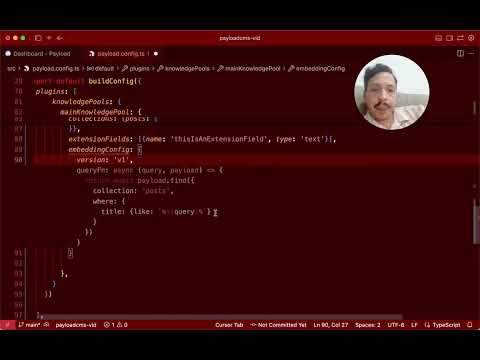
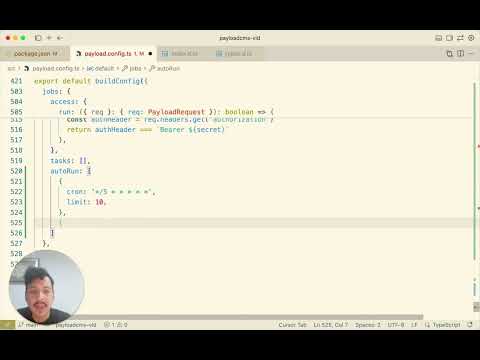
Heads up — these videos are stale. They were recorded against an older version of the plugin and predate the database adapter split. They are still useful as an end-to-end walkthrough for wiring up the PostgreSQL adapter (real-time ingestion, bulk embedding flow, admin UI), but the import paths, package names, and a few config shapes shown on screen have moved. Cross-reference what you see with the current Quick Start and
@payloadcms-vectorize/pgREADME.
A 30-second mental model for contributors:
┌────────────────────────────────────────────┐
│ payloadcms-vectorize (this package) │
│ │
Payload │ • Registers admin collections (runs, │
buildConfig├──► batches, embeddings) │
│ • Hooks into create/update/delete to │
│ queue Payload jobs │
│ • Defines the REST + Local API surface │
│ • Speaks to a generic DbAdapter │
└──────────────────┬─────────────────────────┘
│ DbAdapter interface
▼
┌────────────────────────┐
│ @payloadcms-vectorize │
│ /pg | /cf │
└────────────────────────┘
Key directories:
src/— the core plugin: collections, hooks, jobs, REST endpoints, local API.adapters/pg/— PostgreSQL + pgvector adapter.adapters/cf/— Cloudflare Vectorize adapter.adapters/README.md—DbAdapterinterface contract for new adapters.dev/— a working Payload app used for tests and manual verification.
Job model:
vectorize-realtime(default queue) — single per-document embed jobs triggered by Payload create/update hooks.prepare-bulk-embedding— coordinator job that fans out one worker per collection for bulk runs.poll-or-complete-single-batch— polls a single provider batch, requeues itself until terminal, then writes embeddings.
See Bulk Embeddings API → Bulk Task Model for the long version.
Contributions are welcome — please open an issue or PR. We're especially looking for help adding more database adapters! If you use MongoDB Atlas, SQLite, Pinecone, Qdrant, or any other vector-capable database with Payload CMS, we'd love your help building an adapter. See adapters/README.md for the DbAdapter interface and how to get started. Open an issue to coordinate before starting work.
If this plugin is useful to you, star the repo and open issues for bugs, feature requests, docs gaps, or questions — community engagement directly drives our priorities.
Setup:
pnpm install
pnpm test:setup # Boots the test Postgres via docker-compose
pnpm dev # Runs the dev Payload app at http://localhost:3000Common scripts:
| Script | Purpose |
|---|---|
pnpm dev |
Run the dev Payload app in dev/ |
pnpm test:int |
Vitest integration tests against the real Postgres in dev/.env.test |
pnpm test:adapters:pg |
PG adapter integration tests |
pnpm test:adapters:cf |
Cloudflare Vectorize adapter integration tests |
pnpm test:e2e |
Playwright end-to-end tests |
pnpm test:setup / :teardown |
Bring the test Postgres up / down |
pnpm lint |
ESLint |
pnpm build |
Build the core plugin and both adapters |
pnpm changeset |
Add a Changeset entry before opening a PR |
Already shipped:
- Multiple Knowledge Pools — independent configurations and embedding functions per pool.
- Database Adapter Architecture — pluggable backends (PostgreSQL, Cloudflare Vectorize, MongoDB today).
- More expressive queries — configurable limits, per-collection scoping, and full Payload-style metadata filtering (see Metadata Filtering).
- Bulk Embed All — admin button, provider callbacks, and run/batch tracking.
- Serverless-friendly job model — bulk runs are split into small, requeueable units (
prepare-bulk-embeddingandpoll-or-complete-single-batch) so individual jobs stay well under typical serverless time limits. ThebatchLimitoption (see CollectionVectorizeOption) lets you cap docs-per-job to fit your platform. Tested locally and on Node-style hosts; deeper Vercel-specific integration testing is on the help-wanted list. - Cloudflare Vectorize adapter —
@payloadcms-vectorize/cf. - MongoDB adapter —
@payloadcms-vectorize/mongodb(Atlas + self-hosted Community 8.2+ via$vectorSearch).
Help wanted (priority is driven by community demand — open or 👍 an issue to push something up):
- Additional adapters — Pinecone, Qdrant, SQLite, etc. See adapters/README.md for the
DbAdaptercontract. - Vercel CI matrix — exercising the serverless job model end-to-end on Vercel preview deployments.
Want one of these sooner? Star the repo and open an issue.
See CHANGELOG.md for release history, migration notes, and upgrade guides.
{
  "query": "Your search query",
  "knowledgePool": "mainKnowledgePool",
  "where": {
    "category": { "equals": "guides" },
    "priority": { "gte": 3 },
  },
  "limit": 5,
}