| This project takes several impressoinist painters' work to train GANs that generate art based on their styles as well as providing a comprehensive performance comparison of some of the most used GAN models (DCGAN, ProGAN, WGAN and LSGAN. We also tried to combine WGAN and ProGAN to a new model we called ProWGAN. |
Using the wikiart Dataset, 10 impressionist painters were selected. You can access the exact data used as a zip file here.
LSGAN.ipynb provies a plug-and-play demonstration that runs the LSGAN.py script for easier visualisation as well as training and visualising the results of any of the supported GAN models (by default DCGAN). To use a different GAN model, simply specify the "type" argument at the time of object creation (Available types are "DGCAN", "WGAN", "ProGAN", "ProWGAN").
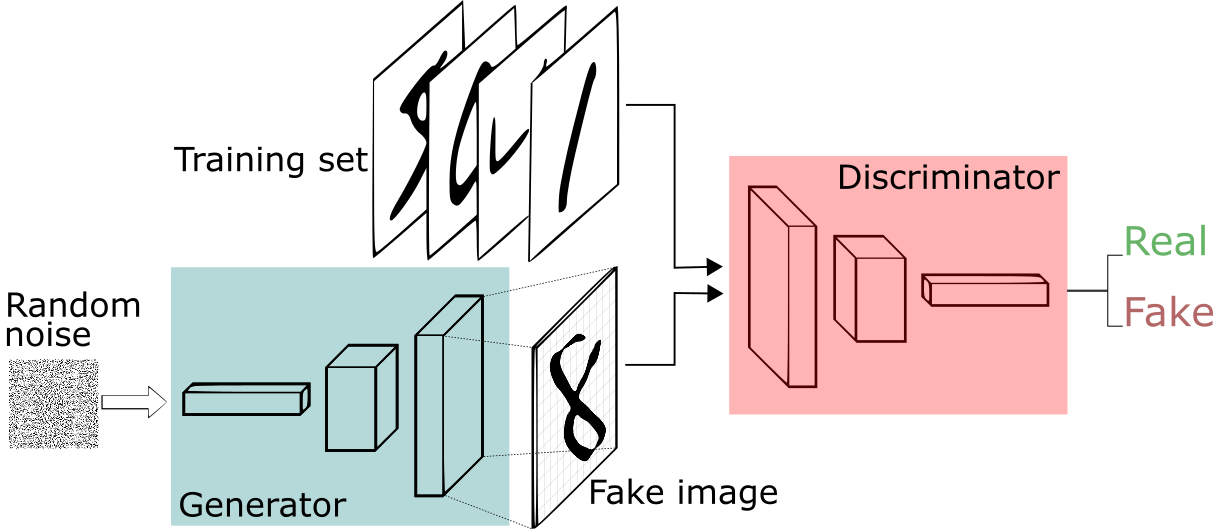
Borrowing ideas from game theory, the main notion of GANs consists in taking 2 adversarial networks (a generator and a discriminator) that strive to reach opposite goals during training. Doing what essentially amounts to a MinMax game, the discriminator is tasked with discerning whether a provided sample is a real painting or a fake image created by the generator. As both models try to optimise the same objective function in different directions, the goal is to reach a state where the generator produces outputs that fool the discriminator.