
A lightweight, mountable dashboard for paper_trail.
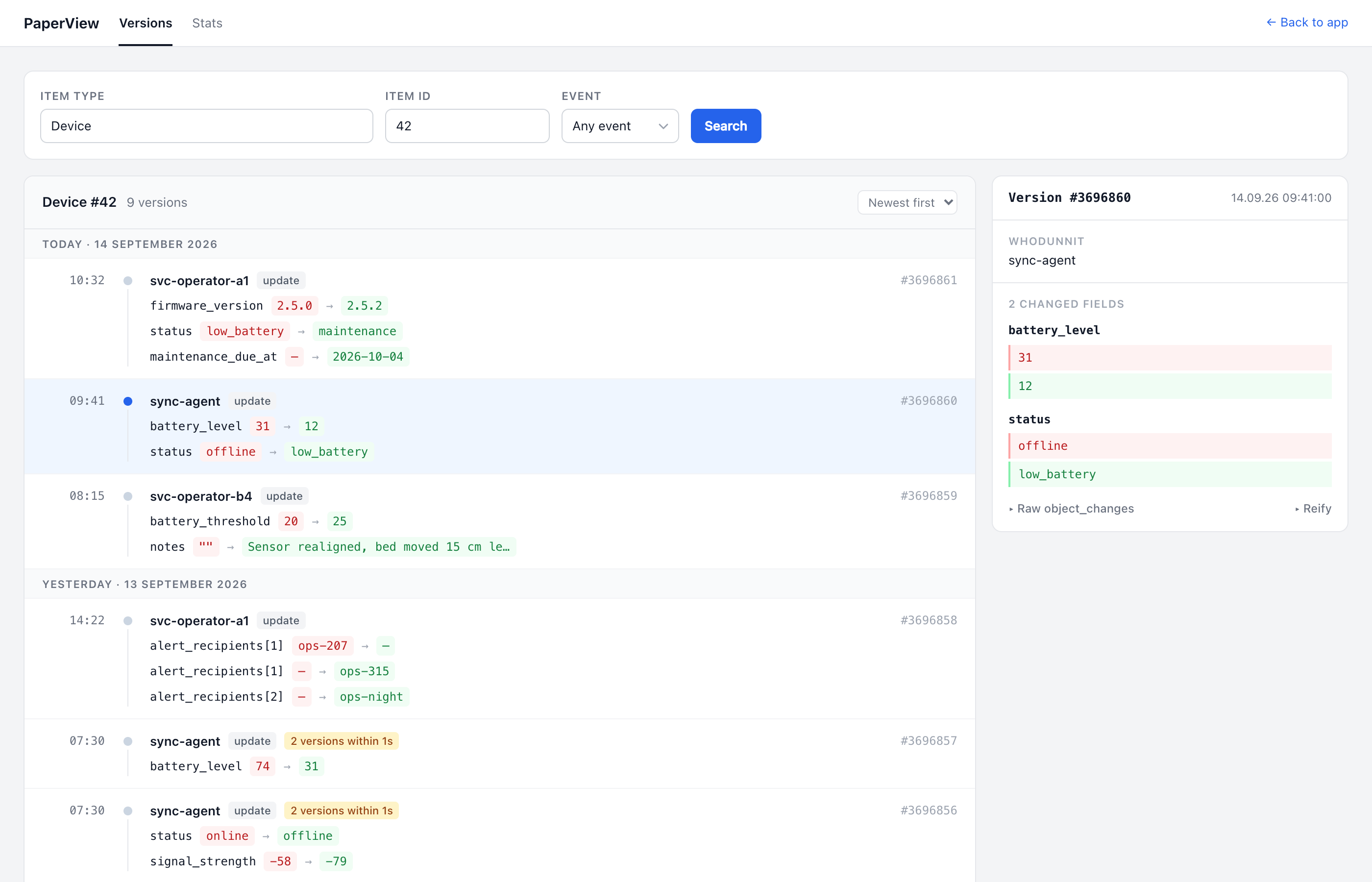
Browse the versions table and read, in a chronological timeline, what actually changed.
# Gemfile
gem "paper_view"# config/routes.rb
Rails.application.routes.draw do
authenticate :user, ->(user) { user.admin? } do
mount PaperView::Engine => "/versions"
end
end# config/initializers/paper_view.rb
PaperView.setup do |config|
# Inherit from your own controller so that Devise/Pundit/layout helpers are available.
config.parent_controller = "ApplicationController"
# Runs as a before_action, evaluated inside the controller instance.
config.authenticate_with { redirect_to main_app.root_path unless current_user&.admin? }
# Must return a truthy value, otherwise the request is answered with 403.
config.authorize_with { current_user.admin? }
# Turn `whodunnit` into something readable.
config.whodunnit_label = ->(whodunnit) { User.find_by(id: whodunnit)&.email || whodunnit }
# Any strftime format.
config.time_format = "%Y-%m-%d %H:%M:%S"
config.per_page = 25
# The exact columns to show as metadata. Defaults to every column that
# paper_trail does not write itself, so usually nothing has to be set here.
# config.metadata_columns = %w[ip user_agent]
# Any model with the paper_trail column layout works here.
# Required interface: id, item_type, item_id, event, whodunnit, created_at, object_changes
config.version_class_name = "PaperTrail::Version"
endVisit /paper_view.
paper_trail can store extra columns on a
version, either through has_paper_trail meta: { ... } or through controller_info:
class Post < ApplicationRecord
  has_paper_trail meta: {author_id: :author_id}
end
Every column of the versions table counts as metadata, except the ones paper_trail writes itself:
id, item_type, item_subtype, item_id, event, whodunnit, object, object_changes,
created_at, updated_at and transaction_id.
Set config.metadata_columns to the exact list you want if your table carries columns you would
rather not see — anything left out of that list is then hidden.
To work properly, PaperView requires an object_changes column in your versions table. This can be added by running the installation generator with the --with-changes option. This can be done even if you already have a versions table; it will generate a migration that adds the object_changes column to your existing versions table:
rails generate paper_trail:install --with-changes