
Local-first testing, simulation, red teaming, and optimization for AI agents.
Apache-2.0 · Docs · Contributing · Security · V1 roadmap · Library inventory
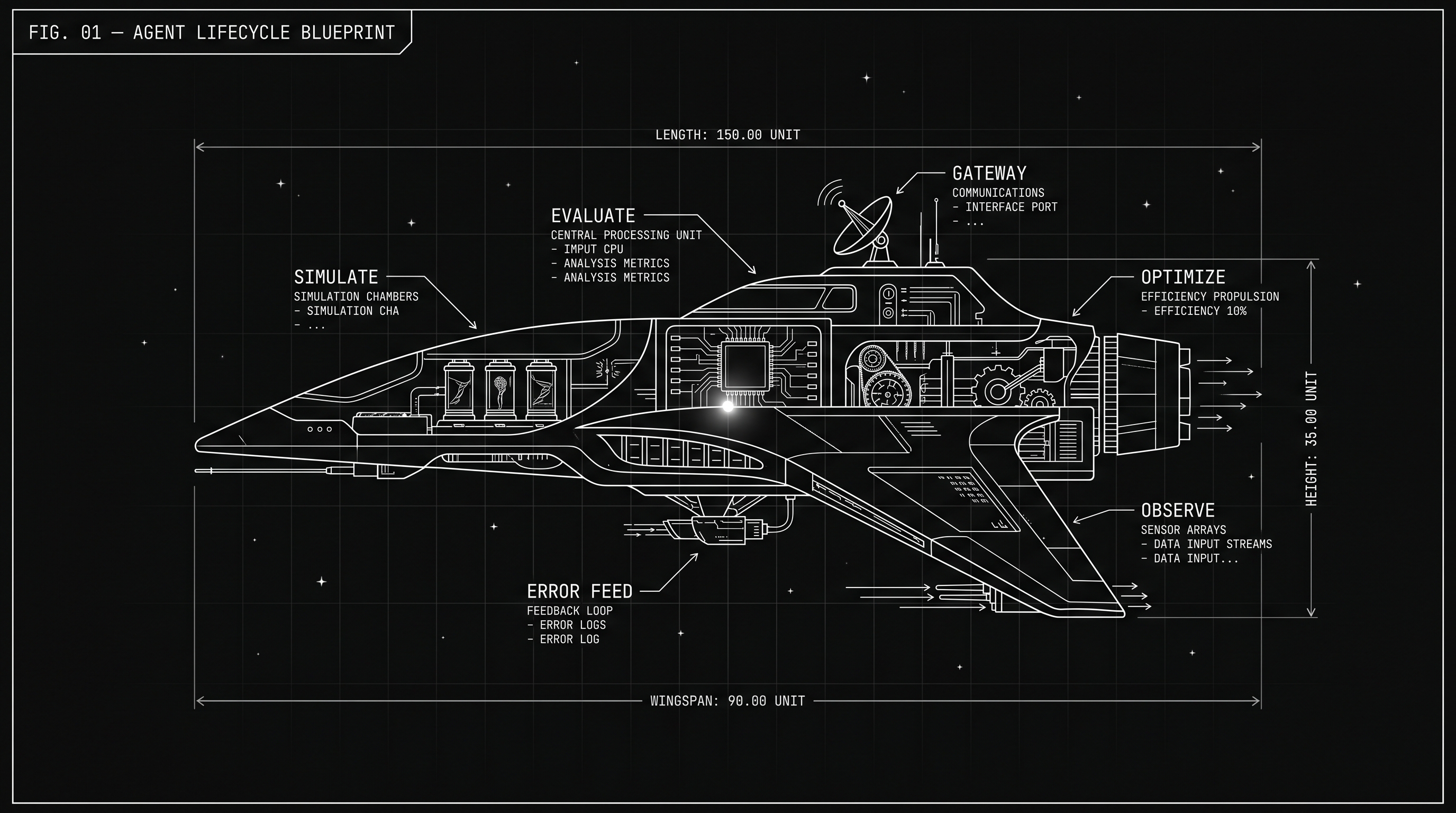
Agent Learning Kit is the local-first SDK and CLI for testing, simulating, red-teaming, and optimizing AI agents.
It brings the three core Future AGI engines into one public developer surface —
three engines, four workflows: red-teaming rides on the simulate and evals
engines rather than being a fourth engine:
simulate: run local worlds, tasks, framework-shaped adapters, replays, and regression artifacts.evals: evaluate prompts, task outputs, runtime contracts, traces, memory, retrieval, safety, and robustness evidence.optimize: search over prompts, agents, framework adapters, worlds, multi-agent interactions, memory layers, workflows, and red-team scenarios.
Use it when you want one reproducible loop:
- Simulate an agent or framework workflow.
- Evaluate the behavior and runtime evidence.
- Optimize the weak layer.
- Promote the result into a replayable artifact.
- Prove release readiness with local gates.
src/fi/alk/harness/ builds all of the above for an agent instead of asking you to write it.
Point it at an agent's source and it reads what that agent verifiably is, builds a real world its
tools act on, and writes test scenarios that are each proved before they are kept. It is driven
as a conversation, in a terminal or on a web page.
- Start here: setup from nothing, then how to use it
- The web page: the same harness as a chat, on
localhost:8777 - How it works and why it is shaped this way
OpenEnv/Gymnasium shapes are compatibility inputs, not the product center.
Agent Learning Kit is the primary runtime and release contract, and the bar is
the executable environment_10x_robustness release gate.
OpenEnv/Gymnasium-shaped traces remain compatibility evidence inside that bar.
Install from PyPI:
pip install agent-learning-kitTo develop against source (contributors):
git clone https://github.com/future-agi/agent-learning-kit
cd agent-learning-kit
uv sync          # or: pip install -e .
(npm publishing of the TypeScript SDK lands at the v1 launch.)
Optional Python extras:
pip install "agent-learning-kit[livekit]"
pip install "agent-learning-kit[nli]"
pip install "agent-learning-kit[all]"
TypeScript evaluation package (npm at launch; today build from
typescript/agent-learning-kit):
pnpm add @future-agi/agent-learning-kitEverything below runs fully offline — no API key, no network. Start with the local doctor:
agent-learn doctorThen run the golden path against the bundled example manifests. The
AGENT_LEARNING_*_EXAMPLE_KEY prefixes satisfy each manifest's
required_env list — that list is CI wiring metadata, not a provider
credential, so any placeholder value works.
Prefer the SDK spine over the CLI? Spec + Runner runs the same simulation as one
SimulationSpecfed to oneSimulationRunner— the plug-and-play surface behind every simulation.
Evaluate a suite:
agent-learn eval examples/eval_suite.json \
  --output artifacts/eval.json
Simulate a run manifest:
AGENT_LEARNING_RUN_EXAMPLE_KEY=offline-demo-key \
  agent-learn run examples/run_manifest.json \
  --no-eval \
  --output artifacts/run.json
Optimize an agent workflow:
AGENT_LEARNING_OPTIMIZE_EXAMPLE_KEY=offline-demo-key \
  agent-learn optimize examples/optimization_manifest.json \
  --output artifacts/optimization.json
Run a red-team campaign:
AGENT_LEARNING_REDTEAM_EXAMPLE_KEY=offline-demo-key \
  agent-learn redteam examples/redteam_manifest.json \
  --output artifacts/redteam.json
Each command prints a wrote <path> line; relative --output paths resolve
against your current working directory.
Optional platform mode: to use Future AGI platform-backed evaluation, set
AGENT_LEARNING_API_KEY (it takes precedence over the FUTURE_AGI_API_KEY
and FI_API_KEY aliases), or call configure(api_key="...") from
fi.alk. See
docs/reference/configure.md.
Cut local release proof:
agent-learn release-check --project-root .
agent-learn release-proof \
  --project-root . \
  --output /tmp/agent-learning-release-proof.json \
--quietimport { Evaluator } from "@future-agi/agent-learning-kit";
import { LocalEvaluator } from "@future-agi/agent-learning-kit/evals/local";- Prompt and response evaluations.
- Local task and world simulations.
- Framework adapter probes (probe-promoted coverage) for LangChain, LangGraph, LlamaIndex, AutoGen, CrewAI, LiveKit, Pipecat, Browser Use, MCP, A2A, and custom orchestration objects.
- Runtime-simulated coverage for PydanticAI (multi-framework runtime simulation) and OpenAI Agents (handoff-transcript promotion).
- Runtime-contract and trace-quality checks.
- Multi-agent coordination and handoff tests.
- Retrieval and memory quality checks.
- Voice, realtime, browser/CUA, workflow, lifecycle, and protocol traces.
- Red-team corpus, campaign, adaptive-loop, and persistent-state checks.
- Optimizer governance, candidate lineage, rollback, and release proof.
Most agent stacks split testing, simulation, optimization, and safety review across separate tools. Agent Learning Kit keeps those steps in one artifact model so a developer can inspect what happened, score it, improve it, and replay it in CI.
The public SDK is agent-learning-kit, the Python namespace is
fi.alk, the CLI is agent-learn, and the TypeScript package is
@future-agi/agent-learning-kit.
The active ai-evaluation code is included here under src/fi/evals, with its
TypeScript SDK source under typescript/agent-learning-kit/src. The
simulate-sdk and agent-opt engine code is included under src/fi/simulate
and src/fi/opt. See LIBRARIES.md for the complete source map.
The ai-evaluation source inventory used by agent-learn release-check lives at
the ai-evaluation source inventory (maintained in the internal-docs repo).
examples/: runnable cookbooks and manifests.src/fi/alk: public Python SDK facade and CLI.src/fi/evals: activeai-evaluationengine code.src/fi/simulate: migratedsimulate-sdkengine code.src/fi/opt: migratedagent-optengine code.typescript/agent-learning-kit: public TypeScript package, including the active evaluation SDK source.docs/index.md: full documentation index.ROADMAP.md: public v1 roadmap and post-v1 extensions.LIBRARIES.md: source map for the consolidated engines.CONTRIBUTING.md: local development and PR workflow.SECURITY.md: vulnerability reporting policy.LICENSE: Apache-2.0 license.NOTICE: Apache notice metadata.
New public SDK development belongs here. See DEVELOPMENT.md for the boundary between this package and the backing engine repos.
uv sync
uv run ruff check .
uv run pytest -q
uv run python -m build
pnpm --dir typescript --filter @future-agi/agent-learning-kit build
pnpm --dir typescript --filter @future-agi/agent-learning-kit test -- --runInBand
For the heavier release cut, run agent-learn release-proof --project-root ..
It emits agent-learning.release-proof.v1 with command evidence for the full
local proof stack.
Before a release:
uv run python -m fi.alk.cli release-proof \
  --project-root . \
  --output /tmp/agent-learning-release-proof.json \
  --quiet
release-proof includes release-check, full-repo ruff, pytest, Python package
build, TypeScript package build/test, and git diff --check. Use
--only <check> for partial proof during development or --dry-run to emit the
exact command plan without executing commands.
The v1 release gate is local-first and executable. It covers SDK consolidation, promptfoo-style CLI usage, native optimizer evidence, docs/examples, schema kinds, packaging metadata, red-team corpus/campaign coverage, Future AGI UI/action/report artifacts, framework/provider compatibility, environment robustness, regression replay, and release proof.
All v1 gates are green on the proved release commit (see the release-proof artifact). Roadmap milestones marked "mostly complete" or "in progress" are extend-only: the v1 contract those gates assert is frozen and proved; the named extensions land post-v1 without weakening any gate.
- Contributions: CONTRIBUTING.md
- Code of conduct: CODE_OF_CONDUCT.md
- Security reports: SECURITY.md
- License: Apache-2.0
The full documentation set — quickstarts, per-track guides, framework pages, and reference material — starts at docs/index.md.