🇬🇧 English | 🇫🇷 Français
A sample that shows how to modernize legacy Oracle applications — Oracle Forms and Oracle APEX — into a modern Angular + .NET stack on AWS, using a generative-AI migration pipeline built on Amazon Bedrock. The pipeline reads the legacy artifacts, recovers their business rules into a knowledge base, generates the target code, and validates behavioural equivalence before anything ships.
This is sample code, published to accompany a demonstration/workshop. It is not production software and is provided under the MIT-0 license. Review, harden, and cost-check before any real use. See Security.
Organizations running Oracle Forms and Oracle APEX face end-of-life, security, and skills-retention pressure, but hand-rewriting hundreds of PL/SQL-backed screens is slow and risky. This sample demonstrates an AI-assisted, evidence-based approach:
- Parse the legacy Forms (
.fmb) and APEX export to recover structure and business logic — no AI, fully deterministic. - Index the recovered rules into an Amazon Bedrock Knowledge Base (RAG) so developers can ask questions about the legacy system in natural language.
- Generate the modern Angular + .NET + OpenAPI code with Amazon Bedrock (Anthropic Claude), preserving each recovered rule.
- Validate the result with generated equivalence tests and an optional live shadow mode that diffs the modern app against the legacy system on identical inputs.
The legacy inputs here are legally-clean, public stand-in applications (see The sample legacy apps) so the whole pipeline is reproducible by anyone.
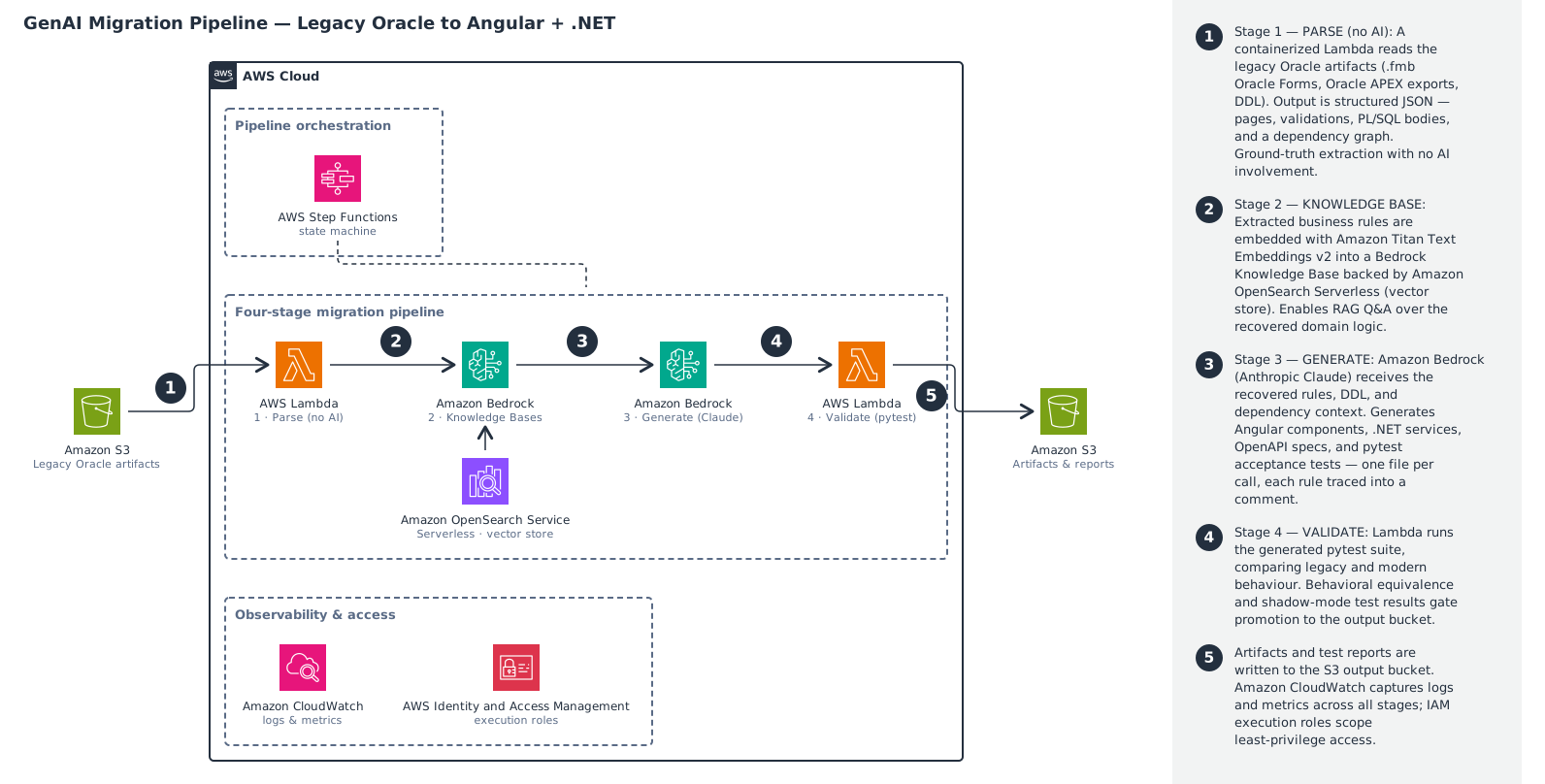
GenAI migration pipeline
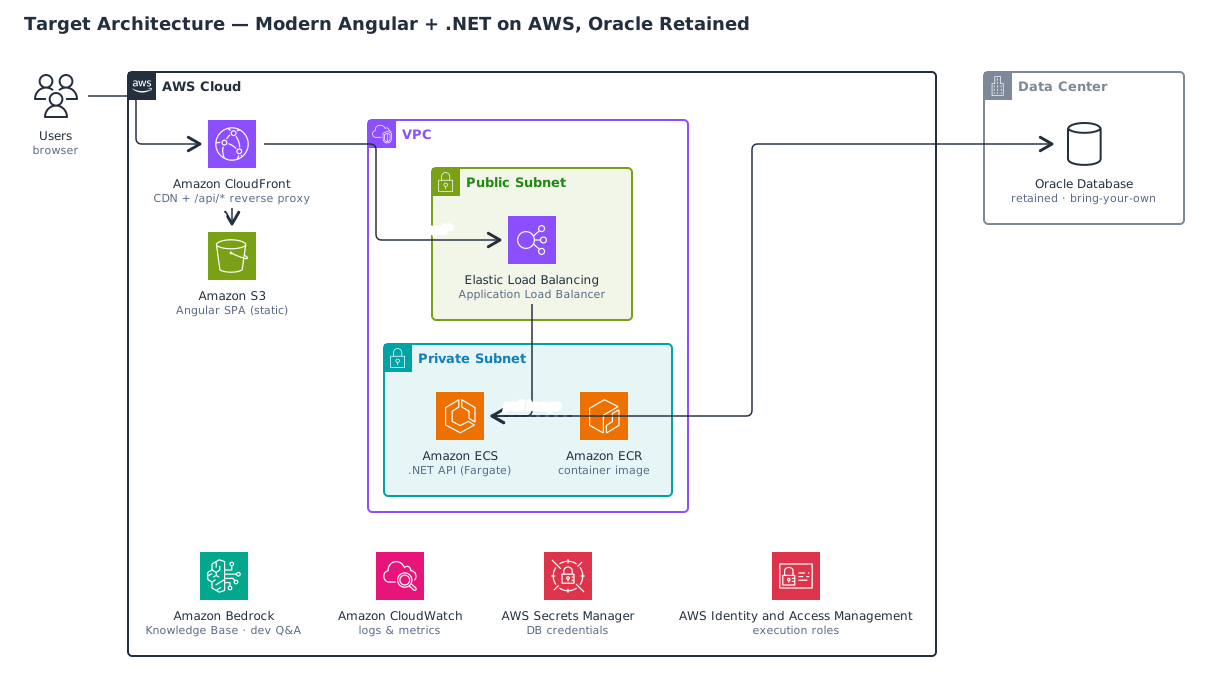
Target "after" architecture
| Stage | Service(s) | What it does |
|---|---|---|
| 1 · Parse | AWS Lambda (container) | Parses Oracle Forms .fmb binaries and the APEX export into JSON; builds a dependency graph and recovers business rules. Pure Python — no AI, runs anywhere. |
| 2 · Knowledge Base | Amazon Bedrock Knowledge Bases · Amazon OpenSearch Serverless · Amazon Titan Text Embeddings v2 | Turns the recovered rules into a Markdown corpus — per-form docs, business rules (intent + PL/SQL), dependency map, and schema (not the raw .fmb) — embeds it with Titan v2, and indexes it in OpenSearch Serverless for RAG with citations. See ARCHITECTURE. |
| 3 · Generate | Amazon Bedrock (Anthropic Claude) | Generates Angular components, a .NET API, an OpenAPI spec, and tests — one file per call to avoid truncation — each recovered rule traced into the output. |
| 4 · Validate | AWS Lambda · generated pytest |
Runs behavioural-equivalence tests. An optional shadow mode runs the same inputs through the legacy system and the modern API and diffs every decision. |
The stages are orchestrated by AWS Step Functions (STANDARD workflow — the chained extended-thinking Bedrock calls exceed the Express 5-minute limit). Artifacts and reports are written to Amazon S3; Amazon CloudWatch provides observability.
- An AWS account with access to Amazon Bedrock models (Anthropic Claude + Amazon Titan Embeddings) enabled in your region.
- AWS CLI v2, AWS CDK CLI (
npm i -g aws-cdk), Docker, Node.js ≥ 22 (required by the Angular 22 build tooling), Python ≥ 3.11, .NET SDK 8. - An Oracle database for the "before"/"after" apps. This sample targets Oracle XE (e.g.
the community
gvenzl/oracle-xe:21-slimimage) — bring your own; no Oracle binaries are redistributed here.
cp .env.example .env          # fill in your values
./scripts/deploy-all.sh       # (Windows: ./scripts/deploy-all.ps1)
deploy-all provisions the infrastructure, builds and pushes the .NET API container, wires
the CloudFront /api/* proxy, then builds and ships the Angular SPA. It prints the CloudFront
URL when done. Before the first run, read docs/DEPLOYMENT.md — it
covers the required TLS decision (acm_cert_arn vs ENABLE_HTTP_SANDBOX=1), the APP_ONLY=1
and ARCH= switches, verification steps, and the optional legacy "before" environments.
To run the migration pipeline against the bundled sample inputs, see
pipeline/README.md.
CDK stacks in infrastructure/cdk:
| Stack | Purpose |
|---|---|
NetworkStack |
VPC, subnets, security groups, ALB |
SecurityStack |
IAM roles, Secrets Manager secret for the DB credential |
StorageStack |
S3 (frontend + artifacts), ECR repo, CloudFront distribution + /api/* proxy |
DatabaseStack |
Oracle XE on EC2 (dev/sandbox) + schema bootstrap |
BedrockKBStack |
Bedrock Knowledge Base + OpenSearch Serverless collection/index |
PipelineStack |
Step Functions state machine + Lambda-container stages |
ApiStack |
ECS Fargate service (the .NET API) behind the ALB |
ObservabilityStack |
CloudWatch dashboards/metrics |
The pipeline's inputs live in pipeline/sample-inputs/ and are
public, permissively-licensed stand-ins — no customer data or proprietary code:
forms/— an Oracle Forms retail application (6.fmbmodules + DDL). Source: oracle-retail-management-system (MIT).apex/opportunities.sql— an Oracle APEX "Opportunity Tracking" sample application (Oracle UPL v1.0).
Oracle schema owners used by the sample are apex_sample (APEX tables) and app_data
(application data). See THIRD-PARTY-LICENSES.
pipeline/            The GenAI migration pipeline (the star of the sample)
  sample-inputs/     Public stand-in Oracle Forms + APEX apps (sanitized)
  stage1_parse/      Parse .fmb / APEX -> JSON + dependency graph  (no AI)
  stage2_kb/         Build corpus + provision Bedrock KB (RAG)
  stage3_generate/   Generate Angular/.NET/OpenAPI/tests via Bedrock
  stage4_validate/   Behavioural-equivalence pytest suites
  stage5_shadow/     Live legacy-vs-modern shadow-mode comparison
  run_pipeline.py    One-command orchestrator over sample inputs
app/
  angular_app/       Modern "after" SPA (Accounts + Reports screens)
  dotnet_api/        .NET 8 API (thin gateway over Oracle via Dapper)
infrastructure/
  cdk/               AWS CDK (Python) — all stacks above
  pipeline/          The same pipeline steps as AWS Lambda container images,
                     orchestrated by Step Functions (deployed by PipelineStack)
scripts/             deploy-all.sh / .ps1, cleanup.sh
docs/                Architecture diagrams
Two views of the pipeline.
pipeline/is the run-it-and-read-it version — plain Python you can execute stage-by-stage oversample-inputs/to understand each step.infrastructure/pipeline/is the same steps packaged as Lambda container images that AWS CDK deploys behind AWS Step Functions (PipelineStack) for the cloud-native, orchestrated run.
- No credentials in code. The .NET API and pipeline read connection details and secrets
from environment variables / AWS Secrets Manager (
.envis git-ignored; see.env.example). - The Angular SPA is served over HTTPS via CloudFront; the API is reached same-origin
through a CloudFront
/api/*reverse-proxy (no mixed content, no CORS). - Sample IAM is scoped for a non-production account. Review and tighten before real use.
- No production data is used anywhere; the legacy inputs are public stand-ins.
See CONTRIBUTING for reporting security issues.
This sample provisions billable resources: Amazon OpenSearch Serverless (the largest
continuous cost), Bedrock inference (per token), ECS Fargate, EC2 (Oracle XE),
CloudFront, and S3. Run scripts/cleanup.sh when you are done.
./scripts/cleanup.sh # cdk destroy --all + empties the S3 buckets- Bedrock "model identifier is invalid" / on-demand not supported — use an inference
profile ARN (e.g.
us.anthropic.claude-...), not a bare model id, and enable the model in your region. - OpenSearch Serverless 401 / timeout on KB ingestion — the collection is
VPC-endpoint-scoped (public access is disabled). Verify that the AOSS VPC endpoint
(
KB_VPC_ENDPOINT_ID) exists, is listed in the collection's network-policySourceVPCEs, and that the caller (Lambda, local script, etc.) runs inside the VPC or routes through that endpoint. Also confirm the data-access policy lists the correct principals (the KB IAM role and your caller identity). Do not enable public access as a workaround. - Angular blank page (NG0908) — ensure
angular.jsonbuild options include"polyfills": ["zone.js"]. - Mixed-content / CORS errors — confirm CloudFront is proxying
/api/*to the ALB and the SPA uses a same-origin (empty) API base URL.
This sample is licensed under MIT-0. See LICENSE. Third-party components remain under their own licenses — see THIRD-PARTY-LICENSES.