
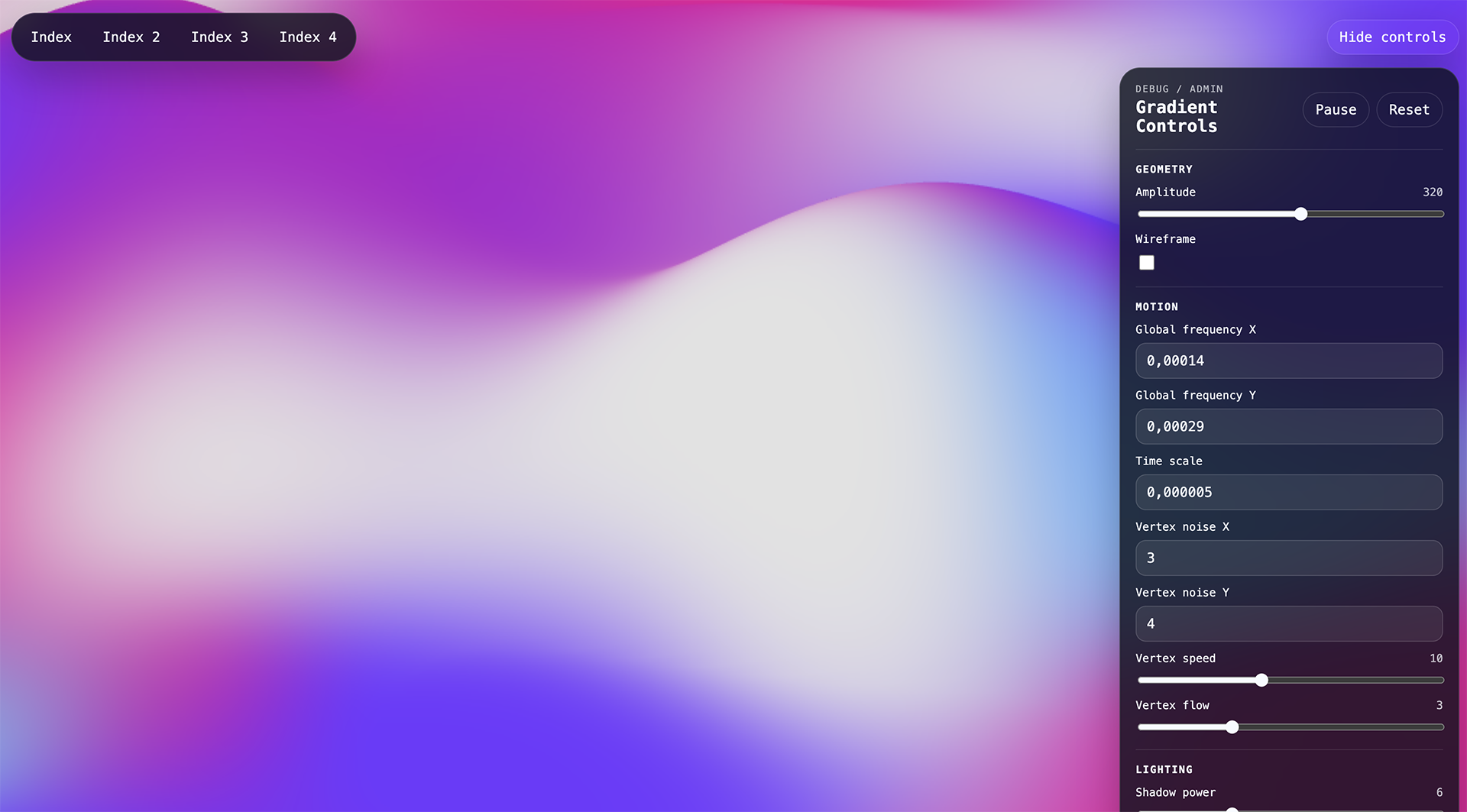
Static WebGL gradient demos based on the Stripe-style animated canvas effect.
Preview: proto.lucidity.design/sites/GradientAnimation/
index.html: demo variant 1index-2.html: demo variant 2index-3.html: demo variant 3index-4.html: demo variant 4Gradient.js: rendering engine and runtime control APIcontrols.js: shared debug/admin overlay and page navigationcontrols.css: shared overlay styling
- Open any of the HTML files directly in a browser, or serve the folder from a simple local web server.
- Each page renders a full-screen canvas and mounts the same debug/admin overlay.
- Top navigation switches between
index.html,index-2.html,index-3.html, andindex-4.html. - The control panel lets you adjust:
- amplitude
- wireframe mode
- global noise frequency X/Y
- time scale
- vertex noise frequency X/Y
- vertex noise speed
- vertex noise flow
- shadow power
- darken-top toggle
- all four gradient colors
Pause/Playtoggles animation.Resetrestores the state captured at page load.Hide controlscollapses the panel.
- Add
?debug=webglto the page URL to enable console-side WebGL debug logging fromGradient.js. - This is log output only; it is separate from the on-page admin overlay.
The Gradient instance now exposes setters that controls.js uses directly:
setAmplitude(value)setGlobalNoiseFrequency(freqX, freqY)setGlobalNoiseSpeed(value)setVertexNoiseFrequency(freqX, freqY)setVertexNoiseSpeed(value)setVertexNoiseFlow(value)setShadowPower(value)setDarkenTop(enabled)setWireframe(enabled)setPlaying(playing)setColor(index, hexValue)getState()applyState(state)
- This project is static and does not use a build step.
- State is not persisted across reloads.
- The HTML files currently have inconsistent
<title>text versus file names; functionality is unaffected.