
An open graph of equations and variables. It can be used to answer the question: given what you know, what else is calculable, and by which equation?
Explore the graph at https://anacoda.github.io/OpenFormulaGraph/
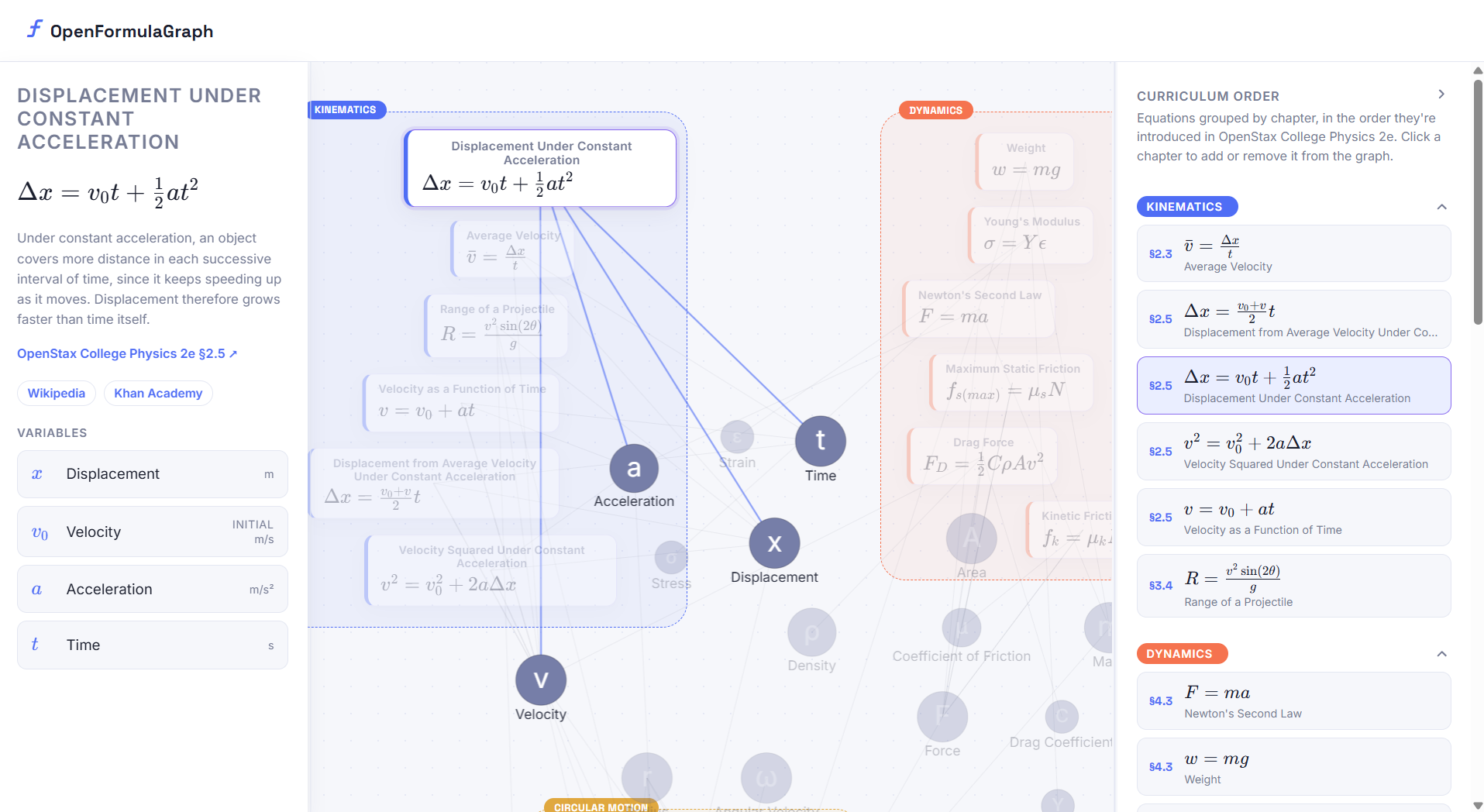
This is a data layer upon which teaching tools like games, quizzes, etc. are meant to be built on top of.
Currently the graph is physics-focused.
data/quantities.yaml: physical quantities (mass, force, velocity...), each with an SI dimension vector.data/equations/*.yaml: one equation per file, in canonical zero form (expr == 0), with its variables, a topic, a source citation, and a numericchecksfixture.
Equations aren't directional: F = ma is equally a way to find m,
computed on demand via SymPy. A variable's optional role
(initial/final, vector components, multiple bodies) allows the
same quantity appear more than once in an equation without ambiguity.
Requires uv.
> uv run ofg calculable mass force time

Calculable:
  Acceleration  (via "Newton's Second Law", F = ma)
> uv run ofg calculable mass force time velocity
Calculable:
Energy (via 'Kinetic Energy', KE = \tfrac{1}{2} m v^2)
Momentum (via 'Linear Momentum', p = mv)
Acceleration (via "Newton's Second Law", F = ma)uv sync
uv run pytesttests/test_dimensions.pychecks every equation for dimensional consistencytests/test_checks.pyruns each equation's numeric example checkofg.model.load_graphenforces that declared variables match the symbols actually used inexpr.
Code: MIT (LICENSE). Data: CC BY 4.0 (LICENSE-DATA), citing OpenStax College Physics 2e, which carries the same license.