diff --git a/src/main/java/g4001_4100/s4015_weighted_sum_of_a_tree/Solution.java b/src/main/java/g4001_4100/s4015_weighted_sum_of_a_tree/Solution.java
new file mode 100644
index 000000000..fd89089fd
--- /dev/null
+++ b/src/main/java/g4001_4100/s4015_weighted_sum_of_a_tree/Solution.java
@@ -0,0 +1,42 @@
+package g4001_4100.s4015_weighted_sum_of_a_tree;
+
+// #Medium #Array #Tree #Senior #Weekly_Contest_514 #Depth_First_Search
+// #2026_11_19_Time_5_ms_(100.00%)_Space_107.29_MB_(94.38%)
+
+public class Solution {
+ public long weightedSum(int[] parent, int[] nums) {
+ int n = parent.length;
+ int[] depth = new int[n];
+ depth[0] = 1;
+ for (int i = 1; i < n; i++) {
+ if (depth[i] != 0) {
+ continue;
+ }
+ int currDepth = getDepth(parent, depth, i);
+ int curr = i;
+ while (depth[curr] == 0) {
+ depth[curr] = currDepth;
+ curr = parent[curr];
+ currDepth -= 1;
+ }
+ }
+ long res = 0;
+ int height = 0;
+ for (int i = 0; i < n; i++) {
+ height = Math.max(height, depth[i]);
+ }
+ for (int i = 0; i < n; i++) {
+ res += (long) (height - depth[i] + 1) * nums[i];
+ }
+ return res;
+ }
+
+ private int getDepth(int[] parent, int[] currDepth, int node) {
+ int add = 0;
+ while (currDepth[node] == 0) {
+ node = parent[node];
+ add += 1;
+ }
+ return currDepth[node] + add;
+ }
+}
diff --git a/src/main/java/g4001_4100/s4015_weighted_sum_of_a_tree/readme.md b/src/main/java/g4001_4100/s4015_weighted_sum_of_a_tree/readme.md
new file mode 100644
index 000000000..02dce8494
--- /dev/null
+++ b/src/main/java/g4001_4100/s4015_weighted_sum_of_a_tree/readme.md
@@ -0,0 +1,70 @@
+4015\. Weighted Sum of a Tree
+
+Medium
+
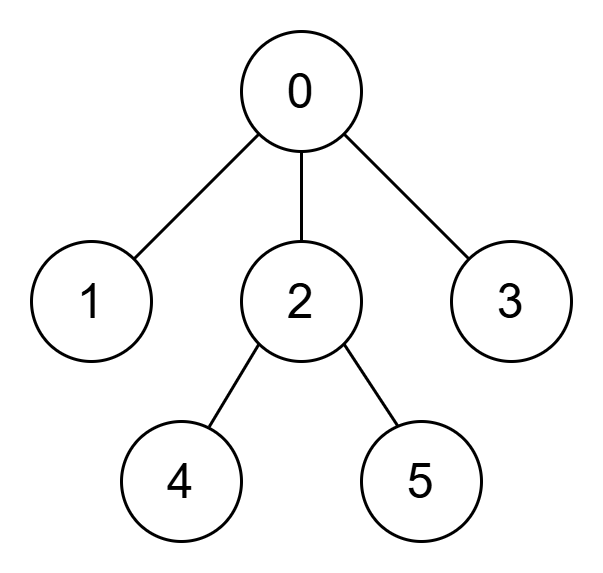
+You are given an integer array `parent` of length `n` representing a rooted tree with nodes labeled from 0 to `n - 1`.
+
+The tree is **rooted** at node 0, so `parent[0] = -1`. For each node `i` where `1 <= i <= n - 1`, `parent[i]` denotes the parent of node `i`.
+
+You are also given an integer array `nums` of length `n`, where `nums[i]` denotes the value of node `i`.
+
+The weight of a node `i` at depth `d` is `nums[i] * (h - d + 1)`, where `h` is the height of the tree.
+
+Return the **sum** of the weights of all nodes in the tree.
+
+The **depth** of a node is the number of nodes on the path from the root to that node, inclusive, with the root having depth 1.
+
+The **height** of the tree is the maximum depth among all nodes in the tree.
+
+**Example 1:**
+
+
+
+**Input:** parent = [-1,0,0,0,2,2], nums = [5,2,3,1,4,6]
+
+**Output:** 37
+
+**Explanation:**
+
+The height of the tree is 3.
+
+| Node | `nums[i]` | Depth (`d`) | Weight |
+| --- | --- | --- | --- |
+| 0 | 5 | 1 | `5 * (3 - 1 + 1) = 15` |
+| 1 | 2 | 2 | `2 * (3 - 2 + 1) = 4` |
+| 2 | 3 | 2 | `3 * (3 - 2 + 1) = 6` |
+| 3 | 1 | 2 | `1 * (3 - 2 + 1) = 2` |
+| 4 | 4 | 3 | `4 * (3 - 3 + 1) = 4` |
+| 5 | 6 | 3 | `6 * (3 - 3 + 1) = 6` |
+
+The sum of all node weights is `15 + 4 + 6 + 2 + 4 + 6 = 37`.
+
+**Example 2:**
+
+
+
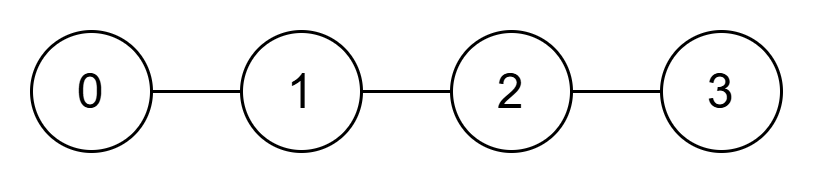
+**Input:** parent = [-1,0,1,2], nums = [1,2,3,4]
+
+**Output:** 20
+
+**Explanation:**
+
+The height of the tree is 4.
+
+| Node | `nums[i]` | Depth (`d`) | Weight |
+| --- | --- | --- | --- |
+| 0 | 1 | 1 | `1 * (4 - 1 + 1) = 4` |
+| 1 | 2 | 2 | `2 * (4 - 2 + 1) = 6` |
+| 2 | 3 | 3 | `3 * (4 - 3 + 1) = 6` |
+| 3 | 4 | 4 | `4 * (4 - 4 + 1) = 4` |
+
+The sum of all node weights is `4 + 6 + 6 + 4 = 20`.
+
+**Constraints:**
+
+* 1 <= n <= 105
+* `n == parent.length == nums.length`
+* `parent[0] == -1`
+* `0 <= parent[i] <= n - 1` for all `i` in `[1, n - 1]`
+* 1 <= nums[i] <= 106
+* The input is generated such that the array `parent` represents a valid tree rooted at node 0.
\ No newline at end of file
diff --git a/src/main/java/g4001_4100/s4016_maximum_area_of_two_non_overlapping_square_submatrices/Solution.java b/src/main/java/g4001_4100/s4016_maximum_area_of_two_non_overlapping_square_submatrices/Solution.java
new file mode 100644
index 000000000..fba901f3a
--- /dev/null
+++ b/src/main/java/g4001_4100/s4016_maximum_area_of_two_non_overlapping_square_submatrices/Solution.java
@@ -0,0 +1,55 @@
+package g4001_4100.s4016_maximum_area_of_two_non_overlapping_square_submatrices;
+
+// #Medium #Array #Dynamic_Programming #Binary_Search #Matrix #Staff #Weekly_Contest_514
+// #2026_11_19_Time_12_ms_(98.63%)_Space_183.92_MB_(94.52%)
+
+@SuppressWarnings("java:S6885")
+public class Solution {
+ public int maxArea(int[][] mat) {
+ int m = mat.length;
+ int n = mat[0].length;
+ int[][] dp = new int[m][n];
+ int[] top = new int[m];
+ int[] bottom = new int[m];
+ int[] left = new int[n];
+ int[] right = new int[n];
+ for (int r = 0; r < m; r++) {
+ for (int c = 0; c < n; c++) {
+ if (mat[r][c] == 0) {
+ continue;
+ }
+ if (r == 0 || c == 0) {
+ dp[r][c] = 1;
+ } else {
+ dp[r][c] = 1 + Math.min(dp[r - 1][c - 1], Math.min(dp[r - 1][c], dp[r][c - 1]));
+ }
+ int k = dp[r][c];
+ top[r] = Math.max(top[r], k);
+ left[c] = Math.max(left[c], k);
+ bottom[r - k + 1] = Math.max(bottom[r - k + 1], k);
+
+ right[c - k + 1] = Math.max(right[c - k + 1], k);
+ }
+ }
+ for (int r = 1; r < m; r++) {
+ top[r] = Math.max(top[r], top[r - 1]);
+ }
+ for (int c = 1; c < n; c++) {
+ left[c] = Math.max(left[c], left[c - 1]);
+ }
+ for (int r = m - 2; r >= 0; r--) {
+ bottom[r] = Math.max(bottom[r], bottom[r + 1]);
+ }
+ for (int c = n - 2; c >= 0; c--) {
+ right[c] = Math.max(right[c], right[c + 1]);
+ }
+ int best = 0;
+ for (int r = 0; r < m - 1; r++) {
+ best = Math.max(best, Math.min(top[r], bottom[r + 1]));
+ }
+ for (int c = 0; c < n - 1; c++) {
+ best = Math.max(best, Math.min(left[c], right[c + 1]));
+ }
+ return best * best;
+ }
+}
diff --git a/src/main/java/g4001_4100/s4016_maximum_area_of_two_non_overlapping_square_submatrices/readme.md b/src/main/java/g4001_4100/s4016_maximum_area_of_two_non_overlapping_square_submatrices/readme.md
new file mode 100644
index 000000000..dc9a93551
--- /dev/null
+++ b/src/main/java/g4001_4100/s4016_maximum_area_of_two_non_overlapping_square_submatrices/readme.md
@@ -0,0 +1,69 @@
+4016\. Maximum Area of Two Non-Overlapping Square Submatrices
+
+Medium
+
+You are given a 2D integer matrix `mat` of size `m × n`, where:
+
+* `mat[r][c] == 1` means the cell at row `r` and column `c` is usable.
+* `mat[r][c] == 0` means it is not usable.
+
+Your task is to find **two submatrices** that satisfy the following conditions:
+
+* Both submatrices must be squares of the same side length `k`.
+* The two submatrices must not share any cell.
+* Each submatrix can only cover cells where `mat[r][c] == 1`.
+
+Return the **maximum possible area** of each of the two squares. If it is not possible to choose two such squares, return 0.
+
+**Example 1:**
+
+
+
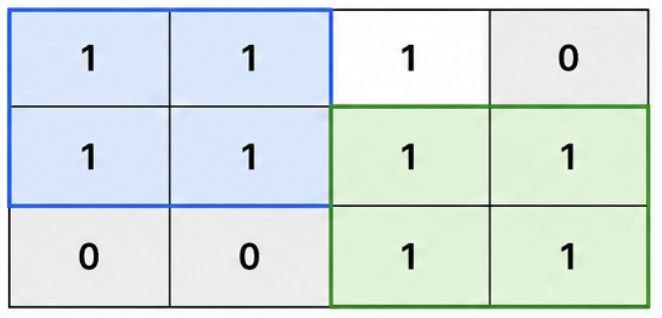
+**Input:** mat = [[1,1,1,0],[1,1,1,1],[0,0,1,1]]
+
+**Output:** 4
+
+**Explanation:**
+
+The largest equal non-overlapping squares have side length `k = 2` with area 4.
+
+* First square starts at top-left `(0, 0)` and covers cells `(0, 0)`, `(0, 1)`, `(1, 0)`, and `(1, 1)`.
+* Second square starts at top-left `(1, 2)` and covers cells `(1, 2)`, `(1, 3)`, `(2, 2)`, and `(2, 3)`.
+
+Thus, the answer is 4.
+
+**Example 2:**
+
+
+
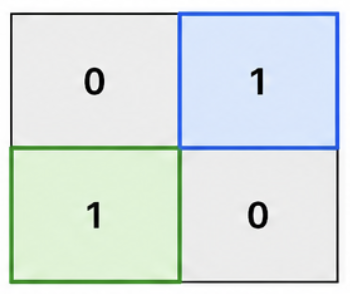
+**Input:** mat = [[0,1],[1,0]]
+
+**Output:** 1
+
+**Explanation:**
+
+The largest equal non-overlapping squares have side length `k = 1` with area 1.
+
+* First square starts at top-left `(0, 1)` and covers cell `(0, 1)`.
+* Second square starts at top-left `(1, 0)` and covers cell `(1, 0)`.
+
+Thus, the answer is 1.
+
+**Example 3:**
+
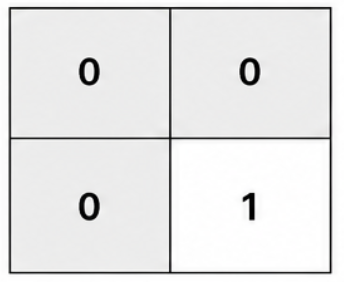
+
+
+**Input:** mat = [[0,0],[0,1]]
+
+**Output:** 0
+
+**Explanation:**
+
+There is only one usable cell, so it is impossible to choose two non-overlapping squares. Thus, the answer is 0.
+
+**Constraints:**
+
+* `mat.length == m`
+* `mat[i].length == n`
+* `1 <= m, n <= 500`
+* `mat[i][j]` is either 0 or 1.
\ No newline at end of file
diff --git a/src/main/java/g4001_4100/s4017_peaks_in_array_ii/Solution.java b/src/main/java/g4001_4100/s4017_peaks_in_array_ii/Solution.java
new file mode 100644
index 000000000..a292139d7
--- /dev/null
+++ b/src/main/java/g4001_4100/s4017_peaks_in_array_ii/Solution.java
@@ -0,0 +1,167 @@
+package g4001_4100.s4017_peaks_in_array_ii;
+
+// #Hard #Array #Divide_and_Conquer #Segment_Tree #Senior_Staff #Weekly_Contest_514
+// #2026_11_19_Time_139_ms_(92.31%)_Space_193.66_MB_(100.00%)
+
+public class Solution {
+ private int[] cnt;
+ private int[] first;
+ private int[] last;
+ private long[] inner;
+ private int qCnt;
+ private int qFirst;
+ private int qLast;
+ private long qInner;
+
+ public long[] countOfPeaks(int[] nums, int[][] queries) {
+ int n = nums.length;
+ int type1Count = 0;
+ for (int[] q : queries) {
+ if (q[0] == 1) {
+ type1Count++;
+ }
+ }
+ long[] ans = new long[type1Count];
+ if (n < 3) {
+ return ans;
+ }
+ int m = n - 2;
+ cnt = new int[4 * m];
+ first = new int[4 * m];
+ last = new int[4 * m];
+ inner = new long[4 * m];
+ build(1, 1, m, nums);
+ int ansIdx = 0;
+ for (int[] q : queries) {
+ if (q[0] == 1) {
+ int l = q[1];
+ int r = q[2];
+ if (r - l + 1 < 3) {
+ ans[ansIdx++] = 0L;
+ } else {
+ qCnt = 0;
+ qFirst = -1;
+ qLast = -1;
+ qInner = 0L;
+ query(1, 1, m, l + 1, r - 1);
+ if (qCnt == 0) {
+ ans[ansIdx++] = 0L;
+ } else {
+ long totalSub = tri((long) r - l + 1);
+ long leftLen = (long) qFirst - l + 1;
+ long rightLen = (long) r - qLast + 1;
+ long nonPeak = (tri(leftLen) - 1L) + qInner + tri(rightLen);
+ ans[ansIdx++] = totalSub - nonPeak;
+ }
+ }
+ } else {
+ int idx = q[1];
+ nums[idx] = q[2];
+ int start = Math.max(1, idx - 1);
+ int end = Math.min(m, idx + 1);
+ for (int pos = start; pos <= end; pos++) {
+ update(1, 1, m, pos, isPeak(nums, pos));
+ }
+ }
+ }
+ return ans;
+ }
+
+ private boolean isPeak(int[] nums, int i) {
+ return nums[i] > nums[i - 1] && nums[i] > nums[i + 1];
+ }
+
+ private long tri(long len) {
+ return len * (len + 1L) / 2L;
+ }
+
+ private void build(int node, int tl, int tr, int[] nums) {
+ if (tl == tr) {
+ if (isPeak(nums, tl)) {
+ cnt[node] = 1;
+ first[node] = tl;
+ last[node] = tl;
+ } else {
+ first[node] = -1;
+ last[node] = -1;
+ }
+ return;
+ }
+ int mid = (tl + tr) >>> 1;
+ build(node << 1, tl, mid, nums);
+ build(node << 1 | 1, mid + 1, tr, nums);
+ pull(node);
+ }
+
+ private void update(int node, int tl, int tr, int pos, boolean peak) {
+ if (tl == tr) {
+ if (peak) {
+ cnt[node] = 1;
+ first[node] = tl;
+ last[node] = tl;
+ } else {
+ cnt[node] = 0;
+ first[node] = -1;
+ last[node] = -1;
+ }
+ inner[node] = 0L;
+ return;
+ }
+ int mid = (tl + tr) >>> 1;
+ if (pos <= mid) {
+ update(node << 1, tl, mid, pos, peak);
+ } else {
+ update(node << 1 | 1, mid + 1, tr, pos, peak);
+ }
+ pull(node);
+ }
+
+ private void pull(int node) {
+ int lc = node << 1;
+ int rc = node << 1 | 1;
+ if (cnt[lc] == 0) {
+ cnt[node] = cnt[rc];
+ first[node] = first[rc];
+ last[node] = last[rc];
+ inner[node] = inner[rc];
+ } else if (cnt[rc] == 0) {
+ cnt[node] = cnt[lc];
+ first[node] = first[lc];
+ last[node] = last[lc];
+ inner[node] = inner[lc];
+ } else {
+ cnt[node] = cnt[lc] + cnt[rc];
+ first[node] = first[lc];
+ last[node] = last[rc];
+ long gap = (long) first[rc] - last[lc] + 1L;
+ inner[node] = inner[lc] + inner[rc] + tri(gap) - 1L;
+ }
+ }
+
+ private void query(int node, int tl, int tr, int ql, int qr) {
+ if (ql <= tl && tr <= qr) {
+ if (cnt[node] == 0) {
+ return;
+ }
+ if (qCnt == 0) {
+ qCnt = cnt[node];
+ qFirst = first[node];
+ qLast = last[node];
+ qInner = inner[node];
+ } else {
+ long gap = (long) first[node] - qLast + 1L;
+ qInner += inner[node] + tri(gap) - 1L;
+ qCnt += cnt[node];
+ qLast = last[node];
+ }
+ return;
+ }
+ int mid = (tl + tr) >>> 1;
+ if (ql <= mid) {
+ query(node << 1, tl, mid, ql, qr);
+ }
+ if (qr > mid) {
+ query(node << 1 | 1, mid + 1, tr, ql, qr);
+ }
+ }
+}
diff --git a/src/main/java/g4001_4100/s4017_peaks_in_array_ii/readme.md b/src/main/java/g4001_4100/s4017_peaks_in_array_ii/readme.md
new file mode 100644
index 000000000..0e45f8f81
--- /dev/null
+++ b/src/main/java/g4001_4100/s4017_peaks_in_array_ii/readme.md
@@ -0,0 +1,74 @@
+4017\. Peaks in Array II
+
+Hard
+
+You are given an integer array `nums` of length `n` and a 2D integer array `queries`.
+
+A **non-empty subarrays** `nums[i..j]` is called a **peak subarray** if:
+
+* Its length is **at least** 3.
+* There exists an index `k` such that `i < k < j` and:
+ * `nums[k] > nums[k - 1]`
+ * `nums[k] > nums[k + 1]`
+
+You have to process queries of two types:
+
+* [1, li, ri]: Calculate the number of **peak subarrays** fully contained within nums[li..ri].
+* [2, indexi, vali]: Update nums[indexi] to vali. This update applies to all subsequent queries.
+
+Return an array `answer`, where `answer[i]` is the answer to the ith query of type 1 in the order they appear.
+
+**Example 1:**
+
+**Input:** nums = [1,3,2,4], queries = [[1,0,3],[2,1,1],[1,0,3]]
+
+**Output:** [2,0]
+
+**Explanation:**
+
+* Query `[1, 0, 3]`:
+ * `[1, 3, 2]`: choose `k = 1`. Then `nums[k] = 3`, `nums[k - 1] = 1`, and `nums[k + 1] = 2`. Since `3 > 1` and `3 > 2`, this is a peak subarray.
+ * `[1, 3, 2, 4]`: choose `k = 1`. Then `nums[k] = 3`, `nums[k - 1] = 1`, and `nums[k + 1] = 2`. Since `3 > 1` and `3 > 2`, this is a peak subarray.
+* Query `[2, 1, 1]`: Update `nums[1]` to 1. The array becomes `[1, 1, 2, 4]`.
+* Query `[1, 0, 3]`: There are no peak subarrays now.
+* Thus, `answer = [2, 0]`.
+
+**Example 2:**
+
+**Input:** nums = [9,8,9,8], queries = [[1,1,3],[2,2,1],[1,0,2]]
+
+**Output:** [1,0]
+
+**Explanation:**
+
+* Query `[1, 1, 3]`:
+ * `nums[1..3] = [8, 9, 8]`: choose `k = 2`. Then `nums[k] = 9`, `nums[k - 1] = 8`, and `nums[k + 1] = 8`. Since `9 > 8` and `9 > 8`, this is a peak subarray.
+* Query `[2, 2, 1]`: Update `nums[2]` to 1. The array becomes `[9, 8, 1, 8]`.
+* Query `[1, 0, 2]`: There are no peak subarrays.
+* Thus, `answer = [1, 0]`.
+
+**Example 3:**
+
+**Input:** nums = [3,6,2,7,1], queries = [[1,1,3],[2,3,0],[1,0,4]]
+
+**Output:** [0,3]
+
+**Explanation:**
+
+* Query `[1, 1, 3]`: The only subarray of length at least 3 is `[6, 2, 7]`. Its only possible peak index is `k = 2`, but `nums[2] = 2` is less than both `nums[1] = 6` and `nums[3] = 7`, so it is not a peak subarray.
+* Query `[2, 3, 0]`: Update `nums[3]` to 0. The array becomes `[3, 6, 2, 0, 1]`.
+* Query `[1, 0, 4]`:
+ * `[3, 6, 2]`: choose `k = 1`. Then `nums[k] = 6`, `nums[k - 1] = 3`, and `nums[k + 1] = 2`. Since `6 > 3` and `6 > 2`, this is a peak subarray.
+ * `[3, 6, 2, 0]`: choose `k = 1`. Then `nums[k] = 6`, `nums[k - 1] = 3`, and `nums[k + 1] = 2`. Since `6 > 3` and `6 > 2`, this is a peak subarray.
+ * `[3, 6, 2, 0, 1]`: choose `k = 1`. Then `nums[k] = 6`, `nums[k - 1] = 3`, and `nums[k + 1] = 2`. Since `6 > 3` and `6 > 2`, this is a peak subarray.
+* Thus, `answer = [0, 3]`.
+
+**Constraints:**
+
+* 3 <= n == nums.length <= 105
+* 0 <= nums[i] <= 105
+* 1 <= queries.length <= 105
+* queries[i] = [1, li, ri] or queries[i] = [2, indexi, vali]
+* 0 <= li < ri <= n - 1
+* 0 <= indexi <= n - 1
+* 0 <= vali <= 105
\ No newline at end of file
diff --git a/src/main/java/g4001_4100/s4020_elevator_requests_i/Solution.java b/src/main/java/g4001_4100/s4020_elevator_requests_i/Solution.java
new file mode 100644
index 000000000..25e7f76f7
--- /dev/null
+++ b/src/main/java/g4001_4100/s4020_elevator_requests_i/Solution.java
@@ -0,0 +1,16 @@
+package g4001_4100.s4020_elevator_requests_i;
+
+// #Easy #Array #Simulation #Mid_Level #Biweekly_Contest_189
+// #2026_11_19_Time_1_ms_(99.23%)_Space_44.25_MB_(70.81%)
+
+@SuppressWarnings("java:S1172")
+public class Solution {
+ public int elevatorRequests(int n, int[] requests) {
+ int time = requests[0];
+ for (int i = 1; i < requests.length; i++) {
+ int currDiff = Math.abs(requests[i] - requests[i - 1]);
+ time += currDiff;
+ }
+ return time;
+ }
+}
diff --git a/src/main/java/g4001_4100/s4020_elevator_requests_i/readme.md b/src/main/java/g4001_4100/s4020_elevator_requests_i/readme.md
new file mode 100644
index 000000000..9018e1bdc
--- /dev/null
+++ b/src/main/java/g4001_4100/s4020_elevator_requests_i/readme.md
@@ -0,0 +1,51 @@
+4020\. Elevator Requests I
+
+Easy
+
+You are given an integer `n` denoting the number of floors in a building, where the floors are numbered from 0 to `n - 1`.
+
+You are also given an integer array `requests`, where `requests` represents the sequence of floor requests.
+
+An elevator starts at floor 0 and follows these rules:
+
+* The elevator moves one floor per second.
+* The elevator serves requests in the given order.
+* If the elevator is already on the requested floor, no movement is needed.
+* After serving a request, the elevator immediately starts moving toward the next request.
+
+Return the **total time** in seconds required to serve all requests.
+
+**Example 1:**
+
+**Input:** n = 5, requests = [2,1,4,3]
+
+**Output:** 7
+
+**Explanation:**
+
+* `requests[0] = 2`: Moving from floor 0 to floor 2 takes 2 seconds.
+* `requests[1] = 1`: Moving from floor 2 to floor 1 takes 1 second.
+* `requests[2] = 4`: Moving from floor 1 to floor 4 takes 3 seconds.
+* `requests[3] = 3`: Moving from floor 4 to floor 3 takes 1 second.
+
+The total time required is `2 + 1 + 3 + 1 = 7` seconds.
+
+**Example 2:**
+
+**Input:** n = 3, requests = [2,0,0]
+
+**Output:** 4
+
+**Explanation:**
+
+* `requests[0] = 2`: Moving from floor 0 to floor 2 takes 2 seconds.
+* `requests[1] = 0`: Moving from floor 2 to floor 0 takes 2 seconds.
+* `requests[2] = 0`: No movement is needed.
+
+The total time required is `2 + 2 + 0 = 4` seconds.
+
+**Constraints:**
+
+* `1 <= n <= 100`
+* `1 <= requests.length <= 100`
+* `0 <= requests[i] <= n - 1`
\ No newline at end of file
diff --git a/src/main/java/g4001_4100/s4021_minimum_operations_to_make_a_rotated_palindrome_i/Solution.java b/src/main/java/g4001_4100/s4021_minimum_operations_to_make_a_rotated_palindrome_i/Solution.java
new file mode 100644
index 000000000..5bb1c9f93
--- /dev/null
+++ b/src/main/java/g4001_4100/s4021_minimum_operations_to_make_a_rotated_palindrome_i/Solution.java
@@ -0,0 +1,42 @@
+package g4001_4100.s4021_minimum_operations_to_make_a_rotated_palindrome_i;
+
+// #Medium #String #Math #Enumeration #Staff #Biweekly_Contest_189
+// #2026_11_19_Time_40_ms_(98.85%)_Space_46.02_MB_(33.33%)
+
+public class Solution {
+ public int minOperations(String s) {
+ char[] chars = s.toCharArray();
+ int n = s.length();
+ int[][] dist = new int[26][26];
+ for (int a = 0; a < 26; ++a) {
+ for (int b = 0; b < 26; ++b) {
+ int diff = Math.abs(a - b);
+ dist[a][b] = Math.min(diff, 26 - diff);
+ }
+ }
+ int[] vals = new int[n];
+ for (int i = 0; i < n; ++i) {
+ vals[i] = chars[i] - 97;
+ }
+ int mid = n >> 1;
+ int min = 0;
+ for (int i = 0; i < mid; ++i) {
+ min += dist[vals[i]][vals[n - 1 - i]];
+ }
+ int[] diff = new int[n << 1];
+ for (int i = 0; i < 2 * n; ++i) {
+ diff[i] = vals[i % n];
+ }
+ for (int shift = 1; shift < n >> (1 - (n & 1)) && shift < min; ++shift) {
+ int curr = shift;
+ for (int i = 0; i < mid; ++i) {
+ curr += dist[diff[shift + i]][diff[shift + n - 1 - i]];
+ if (curr >= min) {
+ break;
+ }
+ }
+ min = Math.min(min, curr);
+ }
+ return min;
+ }
+}
diff --git a/src/main/java/g4001_4100/s4021_minimum_operations_to_make_a_rotated_palindrome_i/readme.md b/src/main/java/g4001_4100/s4021_minimum_operations_to_make_a_rotated_palindrome_i/readme.md
new file mode 100644
index 000000000..48486342a
--- /dev/null
+++ b/src/main/java/g4001_4100/s4021_minimum_operations_to_make_a_rotated_palindrome_i/readme.md
@@ -0,0 +1,42 @@
+4021\. Minimum Operations to Make a Rotated Palindrome I
+
+Medium
+
+You are given a string `s` consisting of lowercase English letters.
+
+You can perform the following operations any number of times (including zero) and in any order:
+
+* **Increment**: Choose any index `i` and replace `s[i]` with the next lowercase English letter. The letter after `'z'` is `'a'`.
+* **Left rotate**: Move the first character of the string to the end.
+
+Return the **minimum** number of operations required to make `s` a palindrome.
+
+**Example 1:**
+
+**Input:** s = "abc"
+
+**Output:** 2
+
+**Explanation:**
+
+One optimal solution:
+
+* Left rotate the string: `"abc" -> "bca"`.
+* Increment `'a'` to `'b'`: `"bca" -> "bcb"`.
+* `"bcb"` is a palindrome. Thus, the answer is 2.
+
+**Example 2:**
+
+**Input:** s = "yb"
+
+**Output:** 3
+
+**Explanation:**
+
+* Increment the first character three times: `"yb" -> "zb" -> "ab" -> "bb"`.
+* `"bb"` is a palindrome. Thus, the answer is 3.
+
+**Constraints:**
+
+* `2 <= s.length <= 2000`
+* `s` consists only of lowercase English letters.
\ No newline at end of file
diff --git a/src/test/java/g4001_4100/s4015_weighted_sum_of_a_tree/SolutionTest.java b/src/test/java/g4001_4100/s4015_weighted_sum_of_a_tree/SolutionTest.java
new file mode 100644
index 000000000..17b9dc1e6
--- /dev/null
+++ b/src/test/java/g4001_4100/s4015_weighted_sum_of_a_tree/SolutionTest.java
@@ -0,0 +1,23 @@
+package g4001_4100.s4015_weighted_sum_of_a_tree;
+
+import static org.hamcrest.CoreMatchers.equalTo;
+import static org.hamcrest.MatcherAssert.assertThat;
+
+import org.junit.jupiter.api.Test;
+
+class SolutionTest {
+ @Test
+ void weightedSum() {
+ assertThat(
+ new Solution()
+ .weightedSum(new int[] {-1, 0, 0, 0, 2, 2}, new int[] {5, 2, 3, 1, 4, 6}),
+ equalTo(37L));
+ }
+
+ @Test
+ void weightedSum2() {
+ assertThat(
+ new Solution().weightedSum(new int[] {-1, 0, 1, 2}, new int[] {1, 2, 3, 4}),
+ equalTo(20L));
+ }
+}
diff --git a/src/test/java/g4001_4100/s4016_maximum_area_of_two_non_overlapping_square_submatrices/SolutionTest.java b/src/test/java/g4001_4100/s4016_maximum_area_of_two_non_overlapping_square_submatrices/SolutionTest.java
new file mode 100644
index 000000000..d90edf546
--- /dev/null
+++ b/src/test/java/g4001_4100/s4016_maximum_area_of_two_non_overlapping_square_submatrices/SolutionTest.java
@@ -0,0 +1,25 @@
+package g4001_4100.s4016_maximum_area_of_two_non_overlapping_square_submatrices;
+
+import static org.hamcrest.CoreMatchers.equalTo;
+import static org.hamcrest.MatcherAssert.assertThat;
+
+import org.junit.jupiter.api.Test;
+
+class SolutionTest {
+ @Test
+ void maxArea() {
+ assertThat(
+ new Solution().maxArea(new int[][] {{1, 1, 1, 0}, {1, 1, 1, 1}, {0, 0, 1, 1}}),
+ equalTo(4));
+ }
+
+ @Test
+ void maxArea2() {
+ assertThat(new Solution().maxArea(new int[][] {{0, 1}, {1, 0}}), equalTo(1));
+ }
+
+ @Test
+ void maxArea3() {
+ assertThat(new Solution().maxArea(new int[][] {{0, 0}, {0, 1}}), equalTo(0));
+ }
+}
diff --git a/src/test/java/g4001_4100/s4017_peaks_in_array_ii/SolutionTest.java b/src/test/java/g4001_4100/s4017_peaks_in_array_ii/SolutionTest.java
new file mode 100644
index 000000000..2deebd4a2
--- /dev/null
+++ b/src/test/java/g4001_4100/s4017_peaks_in_array_ii/SolutionTest.java
@@ -0,0 +1,127 @@
+package g4001_4100.s4017_peaks_in_array_ii;
+
+import static org.hamcrest.CoreMatchers.equalTo;
+import static org.hamcrest.MatcherAssert.assertThat;
+
+import org.junit.jupiter.api.Test;
+
+class SolutionTest {
+ @Test
+ void countOfPeaks() {
+ assertThat(
+ new Solution()
+ .countOfPeaks(
+ new int[] {1, 3, 2, 4},
+ new int[][] {{1, 0, 3}, {2, 1, 1}, {1, 0, 3}}),
+ equalTo(new long[] {2L, 0L}));
+ }
+
+ @Test
+ void countOfPeaks2() {
+ assertThat(
+ new Solution()
+ .countOfPeaks(
+ new int[] {9, 8, 9, 8},
+ new int[][] {{1, 1, 3}, {2, 2, 1}, {1, 0, 2}}),
+ equalTo(new long[] {1L, 0L}));
+ }
+
+ @Test
+ void countOfPeaks3() {
+ assertThat(
+ new Solution()
+ .countOfPeaks(
+ new int[] {3, 6, 2, 7, 1},
+ new int[][] {{1, 1, 3}, {2, 3, 0}, {1, 0, 4}}),
+ equalTo(new long[] {0L, 3L}));
+ }
+
+ @Test
+ void countOfPeaks4() {
+ // n < 3, no peaks can exist
+ assertThat(
+ new Solution().countOfPeaks(new int[] {5, 10}, new int[][] {{1, 0, 1}}),
+ equalTo(new long[] {0L}));
+ }
+
+ @Test
+ void countOfPeaks5() {
+ assertThat(
+ new Solution().countOfPeaks(new int[] {7}, new int[][] {{1, 0, 0}}),
+ equalTo(new long[] {0L}));
+ }
+
+ @Test
+ void countOfPeaks6() {
+ // Range with fewer than 3 elements yields 0
+ assertThat(
+ new Solution()
+ .countOfPeaks(
+ new int[] {1, 3, 2, 4, 1}, new int[][] {{1, 0, 1}, {1, 2, 3}}),
+ equalTo(new long[] {0L, 0L}));
+ }
+
+ @Test
+ void countOfPeaks7() {
+ assertThat(
+ new Solution().countOfPeaks(new int[] {1, 2, 3, 4, 5}, new int[][] {{1, 0, 4}}),
+ equalTo(new long[] {0L}));
+ }
+
+ @Test
+ void countOfPeaks8() {
+ assertThat(
+ new Solution().countOfPeaks(new int[] {5, 4, 3, 2, 1}, new int[][] {{1, 0, 4}}),
+ equalTo(new long[] {0L}));
+ }
+
+ @Test
+ void countOfPeaks9() {
+ // No type-1 queries, result array is empty
+ assertThat(
+ new Solution()
+ .countOfPeaks(
+ new int[] {1, 3, 2, 4, 1}, new int[][] {{2, 1, 10}, {2, 3, 0}}),
+ equalTo(new long[] {}));
+ }
+
+ @Test
+ void countOfPeaks10() {
+ // Initially no peak in [0,3]; update makes index 2 a peak
+ assertThat(
+ new Solution()
+ .countOfPeaks(
+ new int[] {1, 2, 3, 4},
+ new int[][] {{1, 0, 3}, {2, 2, 10}, {1, 0, 3}}),
+ equalTo(new long[] {0L, 2L}));
+ }
+
+ @Test
+ void countOfPeaks11() {
+ // Initially a peak at index 1; update removes it
+ assertThat(
+ new Solution()
+ .countOfPeaks(
+ new int[] {1, 5, 1, 2},
+ new int[][] {{1, 0, 3}, {2, 1, 0}, {1, 0, 3}}),
+ equalTo(new long[] {2L, 0L}));
+ }
+
+ @Test
+ void countOfPeaks12() {
+ // All equal -> no peaks (peak requires strictly greater)
+ assertThat(
+ new Solution().countOfPeaks(new int[] {3, 3, 3, 3, 3}, new int[][] {{1, 0, 4}}),
+ equalTo(new long[] {0L}));
+ }
+
+ @Test
+ void countOfPeaks13() {
+ assertThat(
+ new Solution()
+ .countOfPeaks(
+ new int[] {4, 2, 0, 4, 2, 14, 13},
+ new int[][] {{1, 5, 6}, {1, 5, 6}, {1, 2, 6}}),
+ equalTo(new long[] {0L, 0L, 5L}));
+ }
+}
diff --git a/src/test/java/g4001_4100/s4020_elevator_requests_i/SolutionTest.java b/src/test/java/g4001_4100/s4020_elevator_requests_i/SolutionTest.java
new file mode 100644
index 000000000..f5dc07eb2
--- /dev/null
+++ b/src/test/java/g4001_4100/s4020_elevator_requests_i/SolutionTest.java
@@ -0,0 +1,18 @@
+package g4001_4100.s4020_elevator_requests_i;
+
+import static org.hamcrest.CoreMatchers.equalTo;
+import static org.hamcrest.MatcherAssert.assertThat;
+
+import org.junit.jupiter.api.Test;
+
+class SolutionTest {
+ @Test
+ void elevatorRequests() {
+ assertThat(new Solution().elevatorRequests(5, new int[] {2, 1, 4, 3}), equalTo(7));
+ }
+
+ @Test
+ void elevatorRequests2() {
+ assertThat(new Solution().elevatorRequests(3, new int[] {2, 0, 0}), equalTo(4));
+ }
+}
diff --git a/src/test/java/g4001_4100/s4021_minimum_operations_to_make_a_rotated_palindrome_i/SolutionTest.java b/src/test/java/g4001_4100/s4021_minimum_operations_to_make_a_rotated_palindrome_i/SolutionTest.java
new file mode 100644
index 000000000..7d1a75379
--- /dev/null
+++ b/src/test/java/g4001_4100/s4021_minimum_operations_to_make_a_rotated_palindrome_i/SolutionTest.java
@@ -0,0 +1,18 @@
+package g4001_4100.s4021_minimum_operations_to_make_a_rotated_palindrome_i;
+
+import static org.hamcrest.CoreMatchers.equalTo;
+import static org.hamcrest.MatcherAssert.assertThat;
+
+import org.junit.jupiter.api.Test;
+
+class SolutionTest {
+ @Test
+ void minOperations() {
+ assertThat(new Solution().minOperations("abc"), equalTo(2));
+ }
+
+ @Test
+ void minOperations2() {
+ assertThat(new Solution().minOperations("yb"), equalTo(3));
+ }
+}